
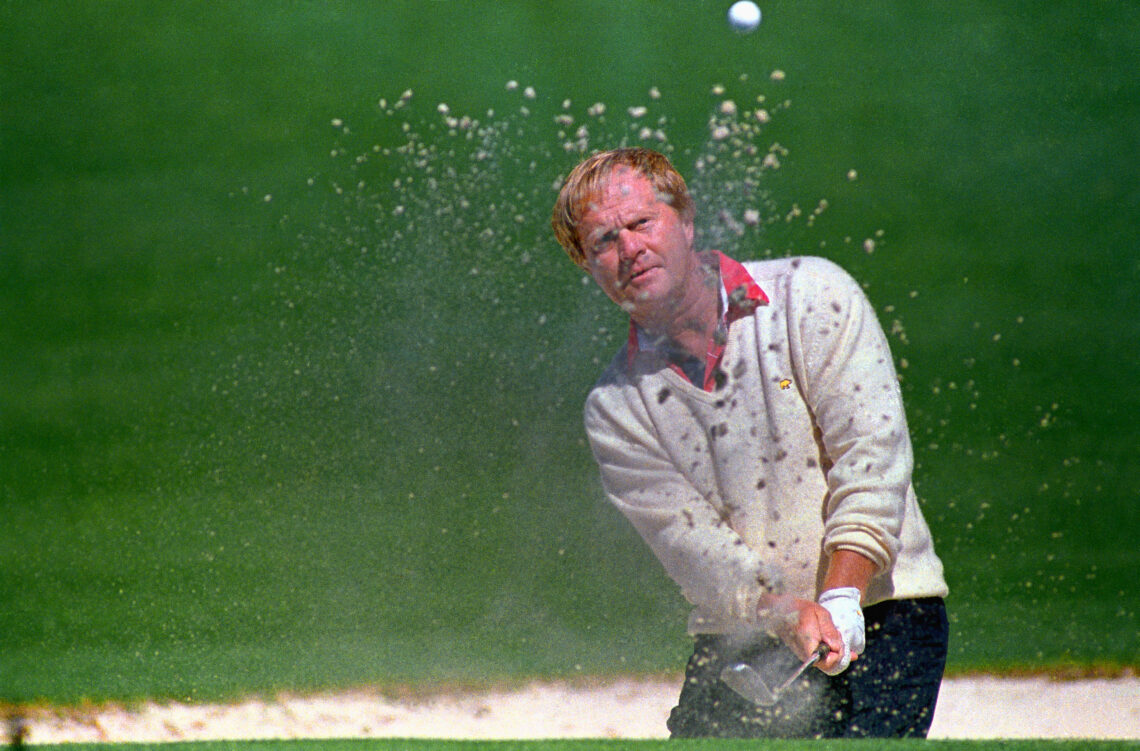

Jack Nicklaus is one of the most naturally gifted golfers to ever play the sport, but even he wasn’t perfect.
Nicklaus holds the record for the most major wins ever with 18. He has the most second-place finishes in major championships with 19, and he has 73 wins on the PGA Tour, the third-most ever.
Nicklaus was a phenomenal player off the tee, a great iron striker, and consistently holed clutch putts under intense pressure. But despite this, he had one glaring weakness.
Lee Trevino claimed that this weakness ultimately cost him a win at the 1971 US Open, and Nicklaus explained to him why he felt no need to improve that area of his game.

Jack Nicklaus’ weakness was his bunker play
The 1971 US Open came down to an 18-hole playoff between Nicklaus and Trevino, after the pair were tied at level par through 72 holes. And it was in that playoff that Nicklaus’ big weakness was exposed: bunkers.
Nicklaus led after a birdie on the first hole, but he found the bunker on the second and third. It took him two attempts to get out each time, leading to two bogeys and allowing Trevino to take the lead. Nicklaus’ opponent would never surrender that advantage.
Nicklaus cut his deficit to one shot at points during the round, but Trevino was able to find crucial birdie putts and went on to win the round by three to claim his second US Open title.
In 2013, Trevino told Golf Digest that it was Nicklaus’ bunker play that won him his second major championship. He said, “I bogeyed the first hole of the playoff to give Jack a one-shot lead, but got it back when he left a ball in the bunker on the second hole and made bogey.
“He left another ball in the bunker at the third to make double, and I took the lead for good. He chunked a wedge from the fairway at the 10th. It’s funny how God doesn’t give everybody everything, and from Jack, He held back the wedge.
“Jack was not a good bunker player. He could play wedges from the fairway OK, but around greens he didn’t have much finesse. Years later, I asked Jack why he wasn’t a good wedge player, and he said, ‘I didn’t need to be. I hit the ball in the fairway and then hit it on the green.’
“If you ever saw Jack play, you could see how that made sense. Still, when you add it up, two things won me that playoff: Jack’s sand wedge, and the rain.”
The rain on Monday caused a delay in play, softening the greens, which suited Trevino’s low ball flight. But ultimately, it was Nicklaus’ mistakes in the bunker on the second and third holes that cost him.
Jack Nicklaus overcoming his weakness is good news for Scottie Scheffler
The PGA Tour didn’t start tracking bunker statistics until the 1980s, when Nicklaus was 40, but we can still paint a clear picture as to how poor he truly was out of the sand.
Between 1980 and 1986, the American won five major championships. During that period, his best sand save rank was 75th on the PGA Tour. He ranked as low as 168th in 1980, and ranked outside the top 120 four times in the six seasons.
But despite that, Nicklaus still won at a historic rate, and that’s great news for Scottie Scheffler. Scheffler has been compared to Nicklaus after his dominant 2025 season, but it turns out he has the same weakness too.
Scheffler is poor out of bunkers, ranking 85th on the PGA Tour in sand saves in 2025. Luckily, his iron play is second to none, keeping him out of the sand consistently enough for this not to be an issue.
That was the same logic used by Nicklaus. If he never hit it into the bunker, then it wouldn’t be an issue. That could give Scheffler some hope that he can cover up his one big weakness for years to come.
Receive exclusive golf news and updates twice a week to your mailbox