
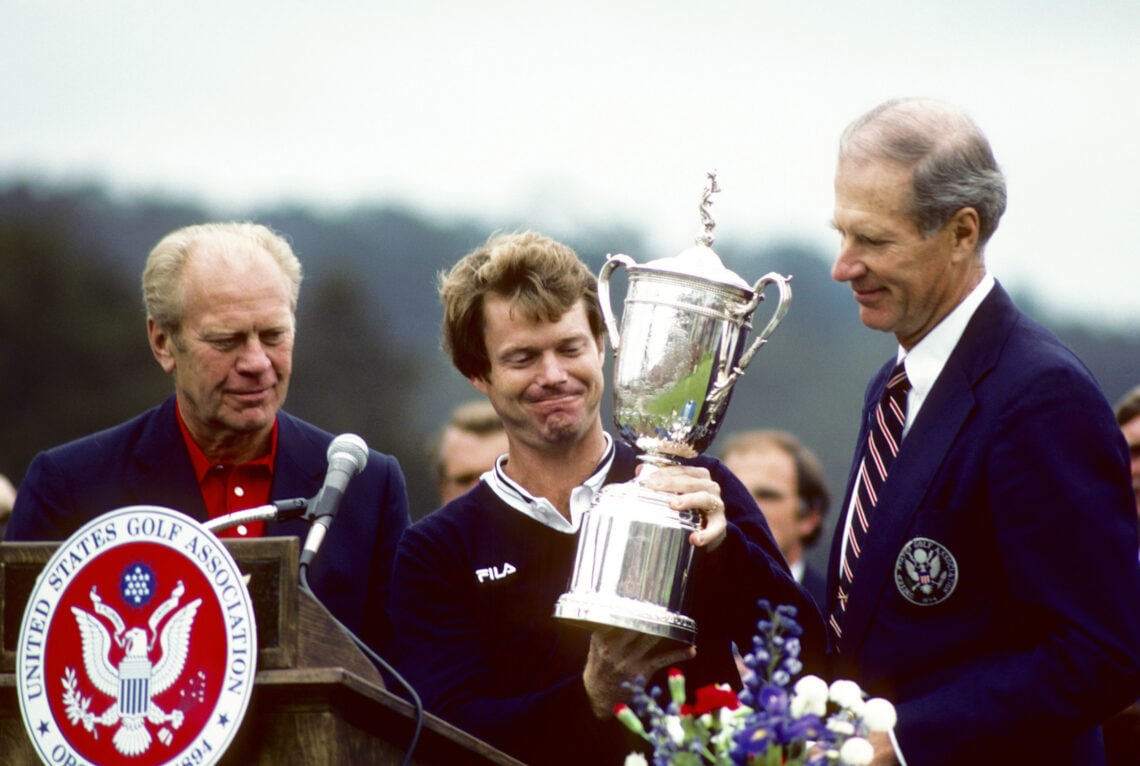

We’ve seen some historically great performances to win major championships over the years.
Tiger Woods’ 15-stroke victory at the 2000 US Open, Scottie Scheffler’s dominant 2025 Open Championship and Rory McIlroy’s 2011 US Open all spring to mind as displays of golfing greatness from some of the best to ever pick up a club.
But the mark of a truly great golfer, or sportsperson for that matter, is their ability to win when they aren’t playing well. When you don’t have your swing, when you’re not feeling comfortable, can you dig deep, and find a way to get it over the line?
That’s exactly what Tom Watson did in 1982. He said he was “swinging awful”, but explained how he was able to overcome it to win his only US Open.

How Tom Watson won the US Open by ignoring his golf swing
In the build-up to the 1982 US Open, Watson was playing some of the worst golf of his career. He gave himself no shot to win the tournament when he arrived at Pebble Beach, but somehow, some way, he beat Jack Nicklaus in one of the greatest short game displays ever seen.
Years later, Watson explained how his poor form with his irons actually proved to be a weapon for him, rather than a hindrance. He told the USGA in 2025, “I didn’t think I had a chance in a million to do well. I was swinging awful.
“I was hitting it sideways, and I wasn’t even chipping all that well. My putting was about the only thing I could rely on.”
But as his opening round drew closer, Watson decided to ignore his approach game completely. He accepted that he’d miss nearly every green, so put an immense amount of work into his chipping.
He continued, “I already figured that I was going to miss a lot of greens, so I spent almost all my time practicing chips and pitch shots around the greens.
Which would you rather eliminate from your golf game?

“The greens are like bowls at Pebble Beach. I hit a lot of shots from the downslopes with lies just like the one I had on Sunday at 17. I practiced that a lot, and I have to credit that to the shot I chipped in. I was confident in my ability and my preparation. I was actually pretty comfortable with what I was facing at the time.”
Watson’s plan was rewarded with one of the greatest shots of all time, the chip on the 17th hole that he mentioned. As expected, he missed the green on the par three, but then holed an impossibly delicate downhill chip shot for a birdie to effectively win him the tournament.
Instead of wrestling with his swing, Watson accepted where his game was at and adapted.
What Sam Snead told Tom Watson about the US Open that made 1982 win more special
Watson was a master of The Open Championship, winning the Claret Jug five times. But it was this victory against Nicklaus at Pebble Beach that meant the most to him.
He explained, “Honestly, the U.S. Open was the one tournament I wanted to win the most. It’s our National Open. I live in this country, and I am an American citizen, born here, so it naturally meant just a little bit more to me. It’s the benchmark of my career as far as what I wanted to do in the game.
Who makes your Mount Rushmore of active golfers?
Any massive names missing out?
“I remember talking to Sam Snead many years ago, and he talked about his heartbreaking loss in the 1939 U.S. Open [when he triple-bogeyed the last hole at Philadelphia Country Club], and he told me, ‘I’ve never gotten that quite out of my head. If I’d have won that one, I might have won 3 or 4 more of them. It just meant that much.’
“I fully understood what Sam was telling me. It does mean that much if you’re an American golfer. It does mean that much.”
Despite countless near misses, Watson only won the event when he least expected to. He took the pressure off himself, and only then could he conquer his demons.
Receive exclusive golf news and updates twice a week to your mailbox