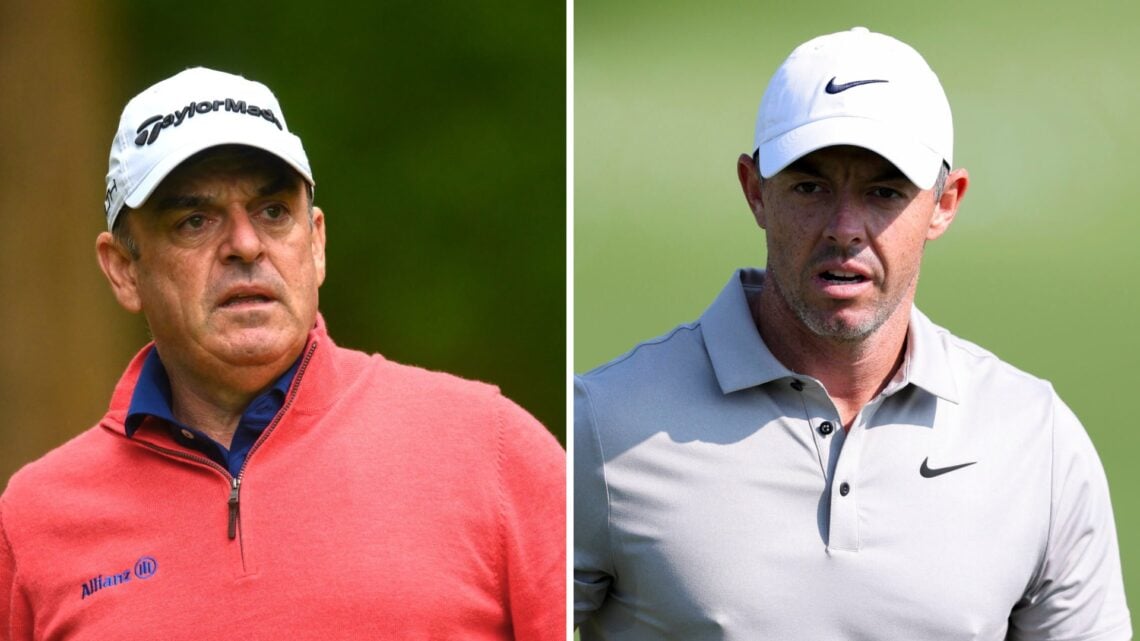

Rory McIlroy got off to a poor start at the 125th US Open at Oakmont on Thursday.
McIlroy burst out of the blocks at Oakmont and was two-under par after his first three holes on day one at the US Open.
However, things got messy for the Northern Irishman on his back nine (the front nine at Oakmont).
He ended up shooting a round of four-over par 74. That was by no means terrible, but it could have been so much better.
McIlroy’s driver was deemed to be non-conforming before the PGA Championship began in May, and things have gone downhill for him ever since then.
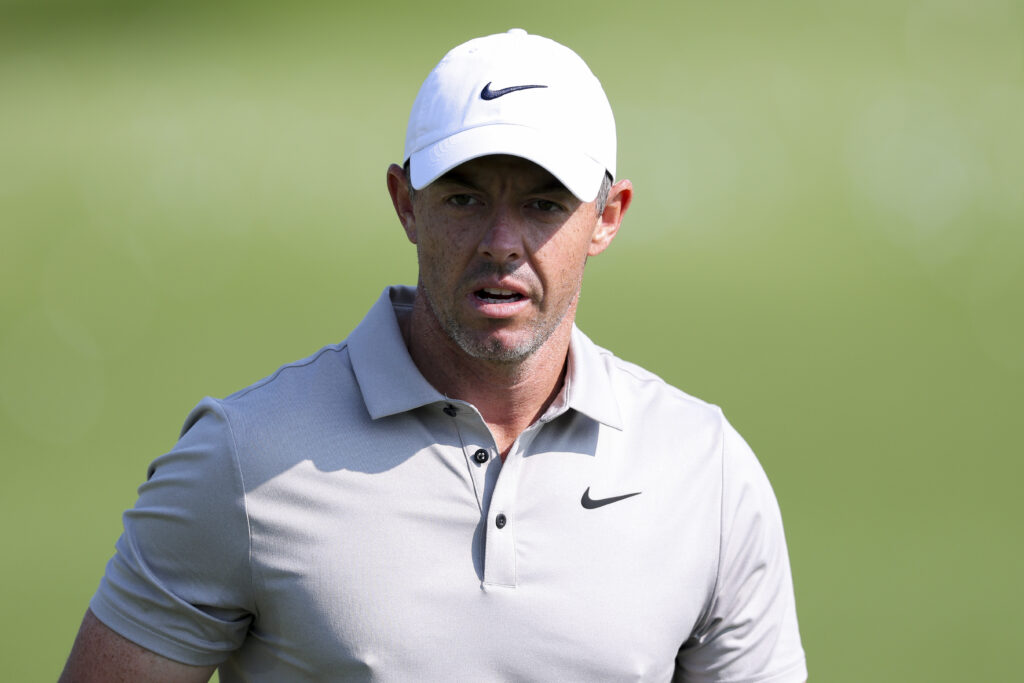
There has been something not quite right with the 35-year-old’s attitude over the past two months.
And McIlroy set tongues wagging before the US Open began by admitting he has been struggling with motivation.
And that showed during his opening round at Oakmont. However, what made it worse was the fact that he once again chose to decline the chance to speak to the media.
Paul McGinley on Rory McIlroy not speaking to the media at the US Open
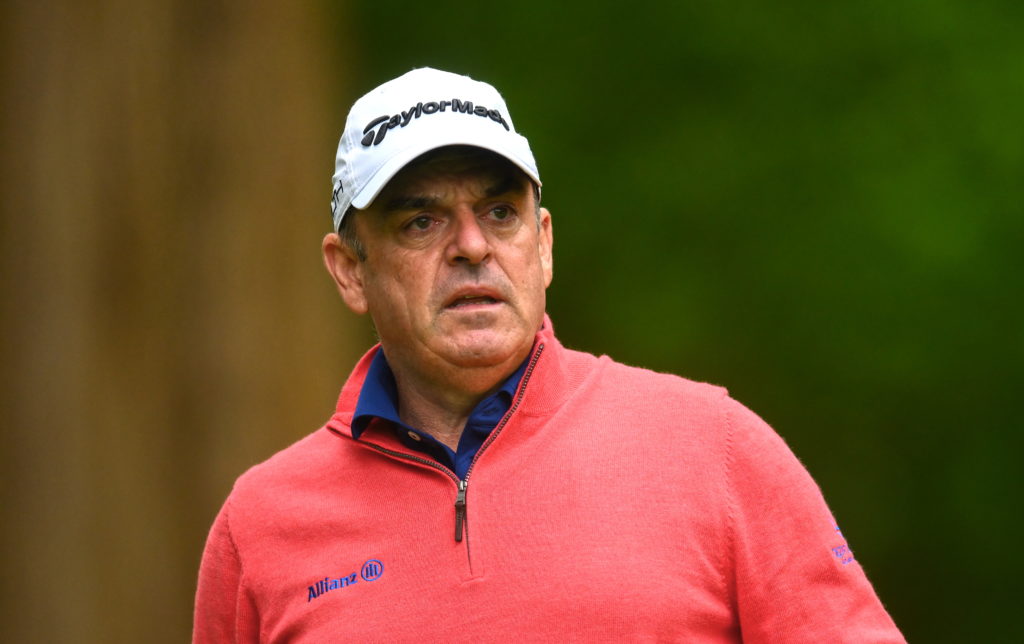
McIlroy’s fellow countryman Paul McGinley offered his take on the world number two’s poor form regarding his media duties recently.
There is talk that golf’s governing bodies need to implement a new rule whereby players like McIlroy are obligated to speak to the press after their rounds.
After five successive rounds in majors without speaking to the media, McGinley explained how his recent behaviour has been so unlike him, when speaking on Sky Sports in the UK.
McGinley said, “His iron play was off. I don’t think he played that badly and then once things unravelled a bit on the back nine he was unable to have that glue to hold it together the way he did at The Masters. We just have not seen the best of Rory at all since The Masters. It was such a monumental achievement.
“It’s not like he has changed out or not interest, it means a lot to him, but the game is just not there. I see him battling and fighting and frustrated that he is not there. Not doing the media is very un-Rory-like. The guy who is probably the best in the media has decided for five rounds in a row at major championships not to engage at all with anybody. That speaks more to him not being contented at all, surprisingly, after completing the Grand Slam.“
Whatever McIlroy’s reasoning is for snubbing the media is, there is simply no excuse. He owes it to his fans to speak to the press after his rounds, whether he’s played well or poorly.
USGA’s statement about driver testing after McIlroy controversy
On Wednesday, USGA chief Mike Whan spoke to reporters about the current driver testing controversy.
He explained the situation very well in all fairness to him, and in real detail.
Whan said, “Just to rephrase a couple of things. For the rest of the world, we test what we call CT creep, characteristic time creep, which is I’m assuming what you’re talking about. That’s essentially how long the ball stays on the face.
“Think about a kid jumping on a trampoline, and the longer they’re on the trampoline, the farther they bounce off. So we set a limit with manufacturers in terms of how long that ball can stay on — it’s tested in terms of microseconds. There’s a test, there’s a tolerance, but at the end of the day, if it’s on there for more than 258 microseconds, we consider that club out of tolerance.
“So as a service to the players, to the tours, and we do it here, as well, we do random testing pretty regularly. I think sometimes when we say “random testing,” people think — if you’re playing on Tour, you’re going to get tested a couple, three times a year, and we think the testing that we’re doing is commensurate with both the degree of failure that we see, which is pretty minimal — and quite frankly, when we see failure, at least currently, we’re seeing clubs just literally creep over the line. It’s a line we draw — we aren’t seeing when we’re taking drivers off, drivers that are, oh, my gosh, look where that one went.
“So I think sometimes in the media and the fan space, you think, we just took 20 yards off that player. We’re literally talking about an extra microsecond, and if you get within I think it’s 18 microseconds of the line and we test you, we give you what we call a yellow warning, which is, hey, be careful, that club is starting to — because at the velocities and at the frequency at which they hit these clubs, they will just relax over time.
“So as a service to manufacturers, to the players and to the tours, we provide that. If I’m being honest with you, I think in terms of what happened at the PGA Championship, it made us more committed to not wanting to have this be the topic of the town because I think when you talked about a rules violation or somebody who’s playing with a hot driver, that gets so much more sensational than the reality.
“I can tell you as a rules body, if we had concern about this incredible advantage, we would change the degree in which we test. But we think the testing that we’re doing now is commensurate with the size of both the issue and the size of the reality of the issue.
“And probably shouldn’t admit this, but I’m not even in the — I know we tested this week. I couldn’t tell you if we had failures, and if so, what those failures were at the time. I could probably go ask, but I stay out of that mix.
“I know that if we saw a trend that was alarming in terms of either how many or how far they were moving beyond, we would change the way we approach it. But with what we’re seeing today, it would be a greater interruption — the juice wouldn’t be worth the squeeze.“
I think as fans, we would like to see more transparency from the governing bodies. If a player’s driver is deemed non-conforming, then name them, because they haven’t done anything wrong after all.
And if they’re not prepared to do that, then they shouldn’t leak any of the players’ names whose drivers have failed the tests.
Receive exclusive golf news and updates twice a week to your mailbox