For many amateur golfers, watching their ball roll into a bunker is the stuff of nightmares.
The ironic thing about that is the fact that a greenside bunker shot is actually the only shot in golf which you do not need to hit perfectly in order to pull off.
We’ve all read numerous golf tips about how to improve out of the sand but it’s fair to say that amateur golfers overcomplicate matters at times.
Gary Player is unquestionably one of the best bunker players of all time.
What is the one golf rule you would change if you had the opportunity?

Player’s tip for better bunker play centered around putting the majority of your weight on your lead side.
- Read also: Three things amateur golfers can do to improve their handicap this winter without leaving the house
Now, we at The Golfing Gazette have compiled a list of the three most common mistakes that amateurs make out of the sand and, more importantly, how to fix them.
*Antony Martin was a plus-four handicap and played on the professional mini-tour circuit in America, winning three times in total. Here are his best three pieces of advice to help improve your bunker play.
Three most common mistakes amateurs make when hitting bunker shots
The beauty of all of this is that improving your bunker play shouldn’t actually be that complicated.
Just a few small changes are required in order to start saving more shots out of the sand around the greens.
Setup
Far too many mid-high handicap golfers approach bunker shots in the same way they would a straightforward chip shot. As they say, fail to prepare and prepare to fail.
It is almost impossible to hit a good bunker shot without the correct setup.
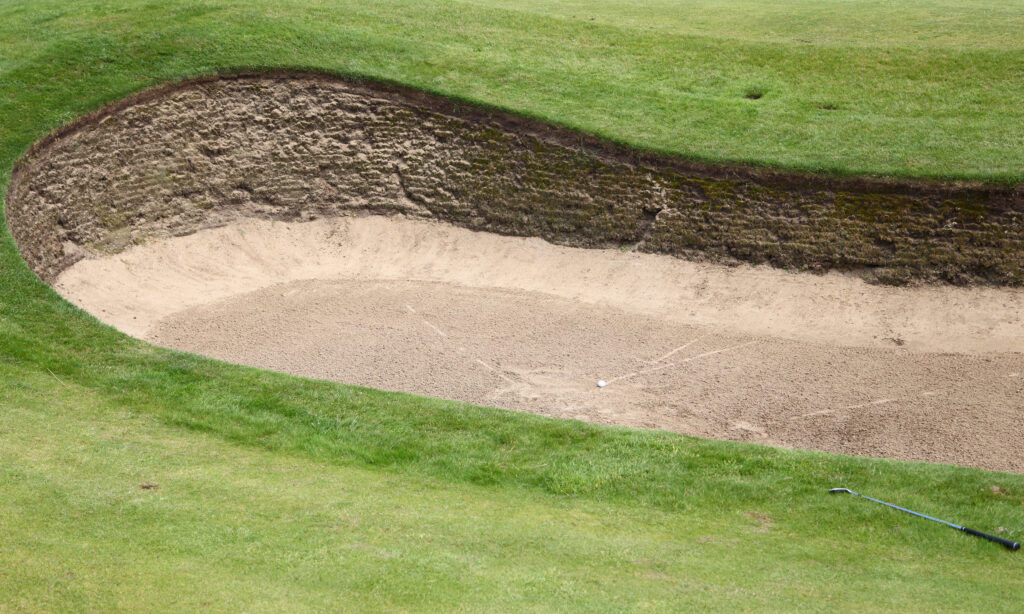
When playing out of the sand, your stance should be slightly open to the target (pointing to the left if you are right handed and vice versa for left handed players).
Your ball position should be slightly forward of center, somewhere in the vicinity of your lead heel. You should then lower your center of gravity and crouch down into a more athletic position.
You should then put at least 60% of your weight onto your lead side, ideally 70% or more.
Once you are set up correctly to the golf ball, your job of extricating yourself from the sand instantly becomes easier.
Club selection
The most common mistake I see amateur golfers make from the sand is choosing the most lofted club in their bag every single time, regardless of what type of shot is required.
Sure, you will need a lob wedge if the pin is cut tight to the edge of the surface and you have minimal green to work with.
However, the majority of shots out of greenside bunkers require less loft. PGA Tour players make bunker shots look so easy but if you’re a mid-high handicapper, you don’t actually need to get up and down out of the sand all the time.
The key is to avoid leaving the ball in the bunker or balding it across the green and keeping the big numbers off your scorecard.
By taking more loft, perhaps a 52 degree wedge or even a pitching wedge, you will give yourself a wider margin for error.
Remember, getting the ball out on the first attempt is our priority and using a club with less loft will limit the risk of the leading edge digging too much into the sand.
Technique
Getting your technique right is the hardest thing about becoming more consistent with your bunker shots.
There are two different methods we are focusing on today. Firstly, if you need to get the ball up quickly and have little green to work with, you must play the shot with even more speed than you usually would.
Speed creates spin and that’s exactly what you will need when playing to a tight pin. In addition to more speed through impact, you have to allow the clubface to outrace your hands. The feeling for this will be your wrists cupping through the hitting area.
What is your craziest golf prediction for the 2026 season?
Our three BOLD golf predictions for 2026!
You need plenty of wrist hinge, a wide arc and finally, your angle of attack has to be steep in order to help you slide the club into the sand and underneath the ball. Remember, you want to be hitting the sand a good 1-2 inches behind the ball.
Your technique will change slightly when faced with a longer bunker shot, where less precision is required in the strike.
If you have plenty of green to work with, your takeaway will need to be wider than when you need to get the ball up in the air quickly.
Less wrist hinge is also needed with more of a horizontal angle of attack, as you will want to avoid digging your club into the sand.
A shallower entry into the sand is required, with more of a long, slow and rhythmic swing.
By putting the tips listed above into practice, your bunker play should improve tenfold. However, without hard and smart work on the practice area, it will be very difficult to get better, as is the case with all aspects of the game.
Receive exclusive golf news and updates twice a week to your mailbox