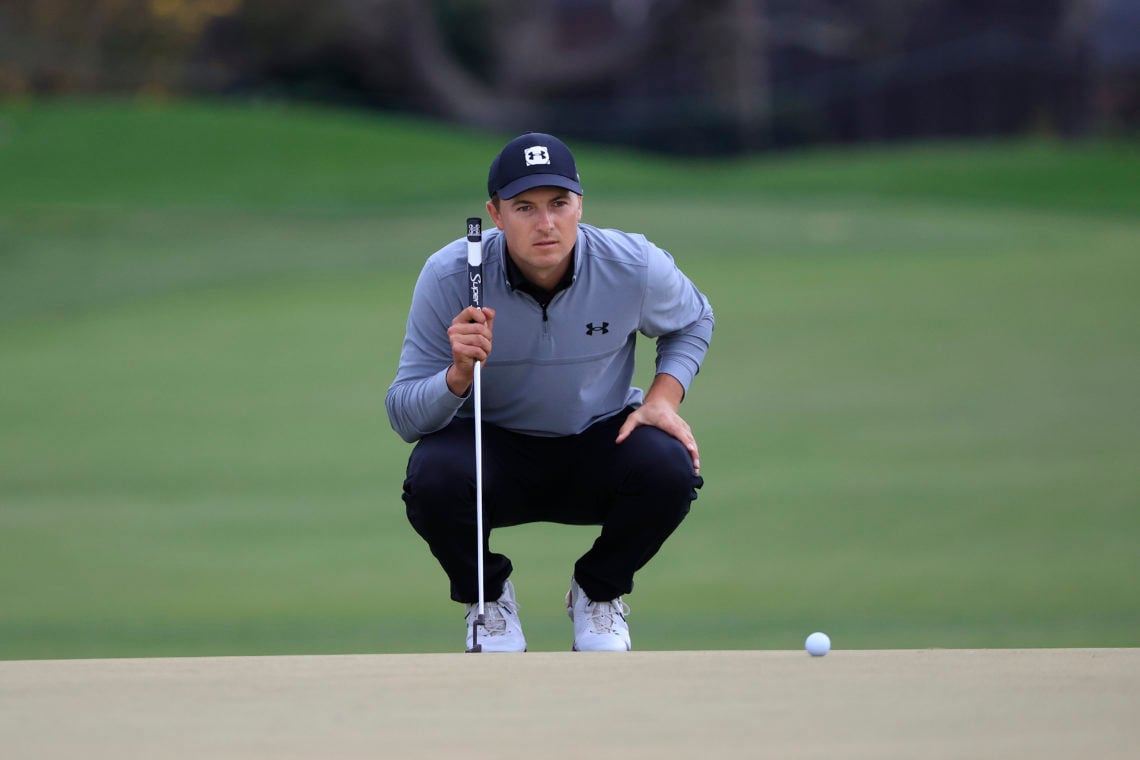

Jordan Spieth has actually struggled with his putting over the past year or so but in his heyday, he was unstoppable on the greens.
Spieth had an uncanny knack of rolling in 30 footers when he desperately needed to, just like the monster putt he holed for eagle on the 15th hole at Royal Birkdale during The Open Championship in 2017.
While the 32-year-old is winless since April 2022, he has always thrilled fans all over the globe with his exciting playing style.
Spieth’s incredible feel on long putts played a crucial role in all three of his major championship victories.
And if Spieth is ever to become the world number one golfer again, he needs to rediscover a feeling on the greens which he describes as ‘blackout’.
Jordan Spieth’s detailed tip list to help amateur golfers reach putting ‘blackout’
Spieth obviously works very hard at his putting, and all of the practice he has put in throughout the years is what has enabled him to reach the very top of the game.
That said, Spieth admitted that once that practice and hard work is done, the best he has ever felt on the greens is when he’s not thinking about his stroke or setup whatsoever.
When speaking to Golf Digest at the height of his powers in 2017, Spieth outlined a detailed tip list for amateur golfers to help them improve their putting.

“I recently hit upon a term that, at least, begins to describe what I feel when I’m putting great: blackout.
“When I’m in “blackout,” I have zero thoughts about my setup or stroke. I’m not even thinking about speed. There’s no challenge in my stance, no body parts pushing for position. I just step in and I’m immediately comfortable. All I see is the arc of a putt with enhanced clarity. Say, the gentle swoop of a 12-footer that breaks a foot. The blur of the ball’s path and that path alone burns in my mind—nothing else. My stroke is simply a reaction to make that path come alive, to come to be, with the roll of the ball.
“As effortless as I might make it out to be, it takes work and preparation to get in that mode. I make no guarantees, but I can show you how I’ve been able to get there. Maybe you can, too.
“When I read a putt, I’m paying sharp attention. It’s a three-step process: First, I look from behind the ball to determine the line.
“Second, I walk along the low side of the putt to gauge the speed because it’s easier to see the slope.
“Third, I walk behind the cup, where I can then judge the line from another perspective. When I’m confident about my read, I step in. I always walk in from behind square to the line, holding the face of my putter in my left hand lightly. Stepping in the same way every time, whatever it is you do, is the one thing you can have total control over if you bother to make the effort.
“First and foremost, what matters is where the putter is aimed. Without near-perfect aim, I don’t think anyone could slip into blackout, even by accident. I set the putter down first with my right hand only. As I aim the face and look at my line, my feet settle into position. This is a point worth stressing: My body accommodates the putter’s position, never the other way around.
“Then I put my left hand on, beneath my right, to take a cross-handed grip. Everything should feel balanced, my weight distributed evenly in my feet and my shoulders level. I might take a couple of practice strokes, or I might not. What I always do is a little forward press—rocking the handle just slightly toward the target—to start my stroke. That press is my trigger, my cue, to let the darkness take over.
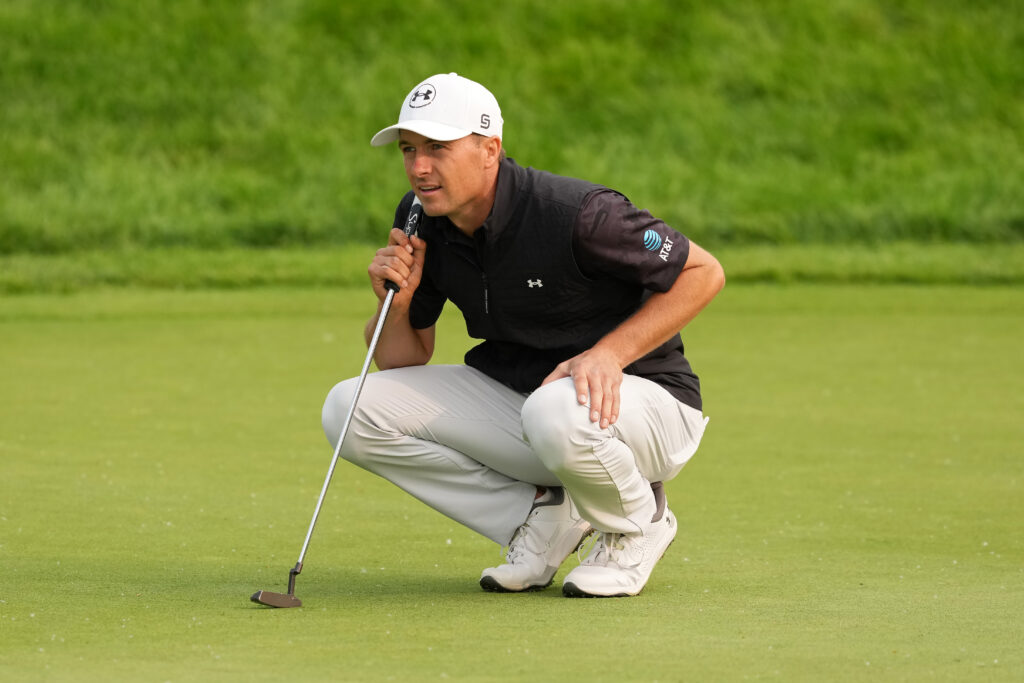
“When I walk around a practice green on the PGA Tour, I can usually tell right away who’s putting great. You can see everything in the finish. Guys who are putting awesome accelerate through the ball, so the putter head and the lead shoulder finish low and forward. Even on soft, short putts, an assertive stroke is immediately recognizable.
“On the other hand, guys who are just hoping to make putts tend to let the putter head and front shoulder rise after impact. It’s like you can see them backing up to watch, curious about where the ball goes. A strong, low finish with the putter head isn’t something I think about during my stroke; it’s just a universal tendency I’ve noticed among the best. As I said earlier, I don’t think about anything when I’m in blackout. It’s a place where you suddenly arrive after a lot of gradual preparation. Though sometimes none at all.“
How amateur golfers compare when putting from long distance
Putting is arguably the most important part of the game.
Solid putting can salvage what would otherwise have been a poor round or turn an average round into a very special one.
However, the fact of the matter is that amateur golfers simply do not make as many putts as you may think.
| Make % | 0 HCP | 5 HCP | 10 HCP | 15 HCP | 20 HCP | 25 HCP |
| 12-18ft | 25.1% | 23.9% | 20.2% | 20.2% | 18.8% | 16% |
| 18-24ft | 14.5% | 13% | 10.3% | 11.2% | 11.8% | 10.1% |
| 24-30ft | 8.3% | 10.1% | 5.4% | 7.8% | 6.8% | 6.3% |
| 30ft+ | 4.3% | 4.3% | 2.8% | 3.2% | 1.9% | 2.3% |
Data provided via Shot Scope.
Amateur golfers clearly hole minimal putts from outside 30 feet, maybe one per round at the absolute most.
However, after Jordan Spieth’s detailed tip list to help you improve your putting, perhaps your performances on the greens will reach new levels.
Receive exclusive golf news and updates twice a week to your mailbox