
The PGA Tour have to make some big changes moving forward, and if the powers that be are bold enough to make one of them in particular, it could be very bad news for Adam Scott and Will Zalatoris.
Scott has enjoyed a wonderfully successful PGA Tour career with 14 wins to his name including a major championship.
Meanwhile, Zalatoris has only won once, but the 29-year-old’s talent is unquestionable. He will undoubtedly go on to win many more events, if he manages to remain injury free.
It’s fair to say that both players’ careers have been saved by switching to the long putter.
Zalatoris and Scott have both suffered with severe putting problems during different stages of their respective careers.
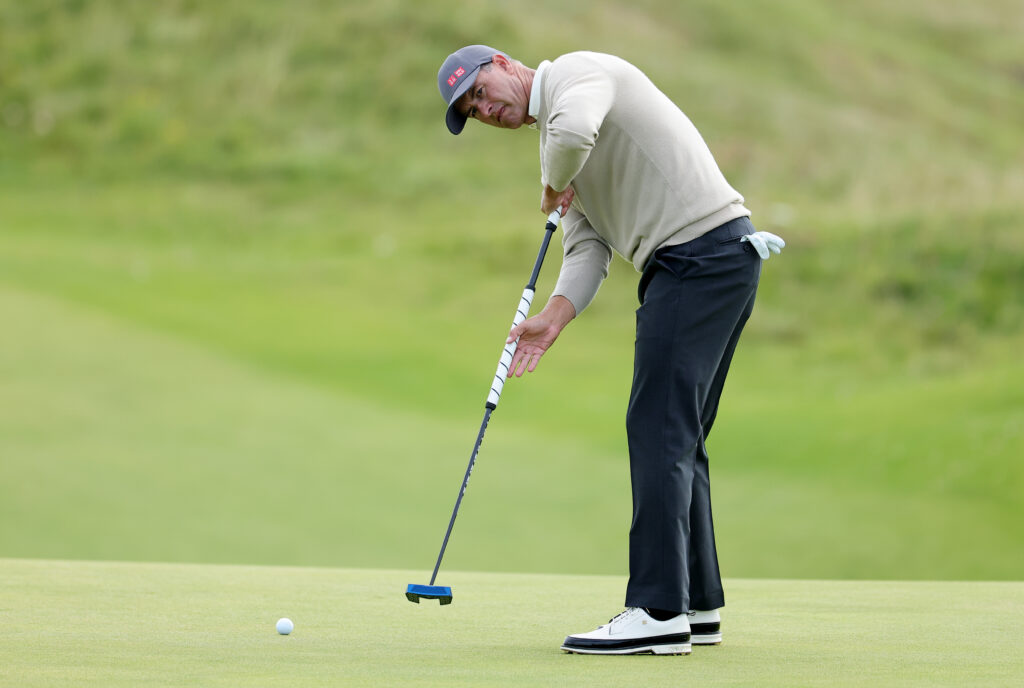
However, with a long putter in their hands, their strokes almost instantly became much smoother.
Scott has actually experimented with a short putter recently, but he has already switched back to the longer model.
Moving forward, though, perhaps he shouldn’t have the option to do that.
PGA Tour rule change would be bad news for Adam Scott and Will Zalatoris
There are numerous rule changes the PGA Tour should consider making ahead of the new season.
However, their priority should be to address their current ‘anchoring ban’ rule.
The anchoring ban was brought into play by the USGA and the R&A back in 2016.
When players were able to anchor the butt of the grip of their putter into their bodies, they were gaining an unfair advantage.
The rules of golf now state that ‘a stroke is a fundamental element that defines the game of golf and is meant to involve the player freely swinging the entire club at the ball’.
That was brought in to prevent certain players gaining an unfair advantage by removing the ‘free swing’ element and instead replacing it with a pendulum-like motion.
It’s simply too hard to make the distinction between anchoring and non-anchoring with the current system.
While players may say they are leaving a minuscule gap between the butt of their grip and their chests, how are we to know?
It certainly isn’t discernible to the naked eye.

So why don’t golf’s governing bodies bring in a new rule whereby golfers are not allowed to carry a putter longer than 38 inches?
The rule would be far simpler to uphold and there would not be any controversy moving forward.
Some fans have accused the likes of Eugenio Chacarra and Matti Schmid of taking advantage of the rules, but the problem is, nobody can be certain one way or the other whether the current protocols are being flouted.
We need a black-and-white rule and a maximum putter length would be the ideal solution.
Long putter vs standard length putter stats and data
A study was performed back in 2016 by four separate professors – Jaeho Shim from Baylor University, Hyuk Chung from Yeungnam University, Glenn Miller from Baylor University and Jitae Kim from Dankook University.
The experiment – The Exploratory Study Investigating Performance Outcomes Between Standard and Anchored Putters – was conducted using two different skillsets.
Experts and novices were given 10 putts each from three feet and 12 feet distances.
Here are the results from the study:
| Putt length | Long putter make percentage | Standard length putter make percentage |
| 3 ft (Novice) | 56.3% | 52.5% |
| 12 ft (Novice) | 17.1% | 10% |
| 3 ft (Expert) | 80% | 71.7% |
| 12 ft (Expert) | 13.3% | 32.5% |
Those numbers make for really interesting reading.
From short distances, it’s conclusive that the long putters, whether they are anchored or not, are much more reliable than standard length models.
The only metric where standard length putters were superior to the ‘broomstick’ variety was in the ‘expert’ category from 12 feet.
The fact that anchoring has been banned since 2016 is a step in the right direction. However, the rule needs to be refined and the PGA Tour should not hesitate to make it happen.
Receive exclusive golf news and updates twice a week to your mailbox