

What has become quite clear in the last few months is that, while most agree that the PGA Tour needs to do so much more to combat slow play, those at the highest levels of the game are struggling to settle on exactly the best way to tackle the problem.
The PGA Tour appears to be ready to change things up to try and finally solve slow play problems. Big changes are planned for 2026, with the number of cards being handed out being reduced. But it seems that they are prepared to act sooner, with a number of options being discussed.
Some have suggested much stronger measures. Colt Knost believes players should be penalised almost immediately if they fall too far behind the group in front. Meanwhile, Lucas Glover had a very interesting take when it came to how some players read the greens.
Glover called for the banning of aimpoint. The 2009 US Open winner even suggested that it is a rude thing to do because it sees players stepping all around the hole as they try to work out the break in their putt.
PGA Tour told what change they should make as Lucas Glover calls for an aimpoint ban
Aimpoint definitely has the potential to slow the game down, with players often looking to measure the break at several points. And Glover argued that it has not even improved the putting statistics of the players who use the method.
The problem is figuring out how a ban would work as players obviously have to stand somewhere on the green to read their putts.
But speaking on The First Cut podcast, Greg DuCharme suggested that there is a way players could be discouraged from using aimpoint without banning the practice.
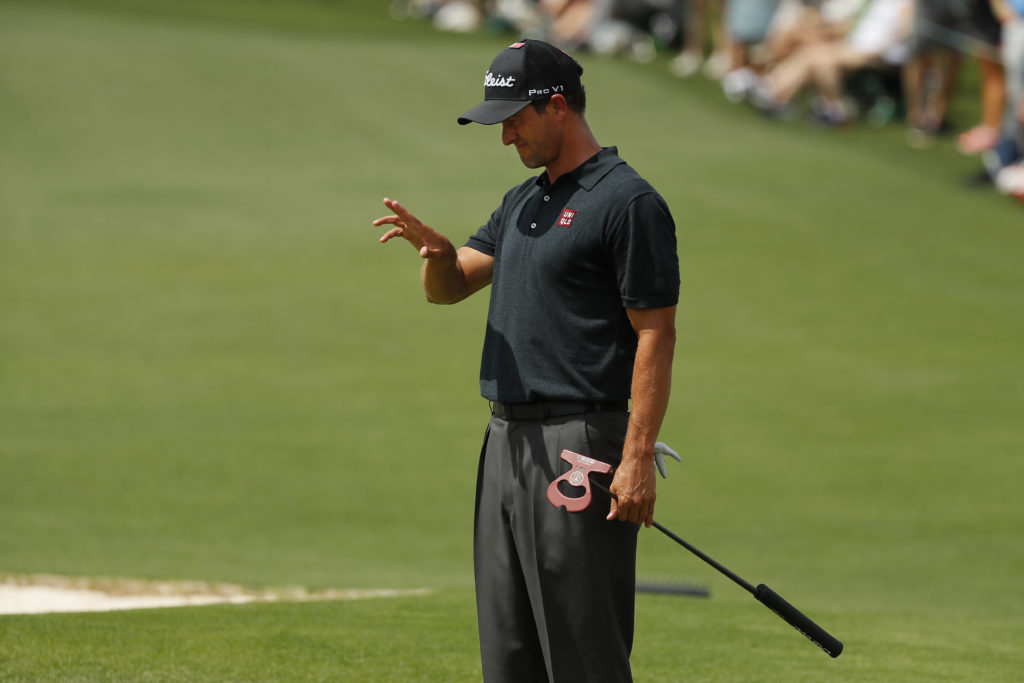
“I’m not a big fan of bans in the game of golf. I wasn’t a fan of banning anchoring, I wasn’t a fan of the wedge groove ban, I wouldn’t be a fan of this ban either. Now, the problem with it is it’s taking so long and we don’t want to watch this,” he said.
“Sunday was great at Pebble. The total time was great. Yet, people are still, including me, frustrated with Tom Kim taking 20 seconds over a ball. When I was a marshal back in the day, people would play in three and a half hours and that’s a fine pace, but if they’re waiting, they’re frustrated. It doesn’t matter what the total time is. It matters if you’re waiting. So again, this goes back to the shot clock. If you have a specific amount of time that every single player, whether we like you or not, you’re allowed a certain amount of time in a very clear and well-defined manner, well, now all of a sudden, you’re within the rules, you’re within the rules. If you’re outside the rules, you get a stroke penalty. It becomes a very simple thing: you want to aimpoint in the middle of that? Go ahead, you better do it quickly.
“I don’t think we have to ban something because we don’t like the way that it looks. But if we can make the game move at the pace we need it to, if you can do those things in the right amount of time, by all means.”
The downside of the PGA Tour introducing a shot clock
Most of the time, a shot clock on the greens would be extremely beneficial. While a shot clock would be tough to enforce for most of the round, it could arguably be a lot easier to work with on the putting surface because all of the players are in the same place. There are also no debates over club selection or where they would ideally like the ball to end up.
However, a shot clock does not come without its downsides. Anyone who watched Sunday at the US Open last year will say that it was one of the gripping final days in a major for a very long time. It was enthralling watching Rory McIlroy and Bryson DeChambeau do all they could to get across the line.
Had a shot clock been in play, it would have arguably taken some of the drama out of the occasion. And had McIlroy missed the same putts he did miss on 16 and 18, you can guarantee that some will have pointed to the time constraints as a reason he failed to get across the line.
Golf needs to weigh up whether the benefit of a shot clock at most events outweighs the possible downsides which may come in what could be the sport’s most amazing moments.
Receive exclusive golf news and updates twice a week to your mailbox