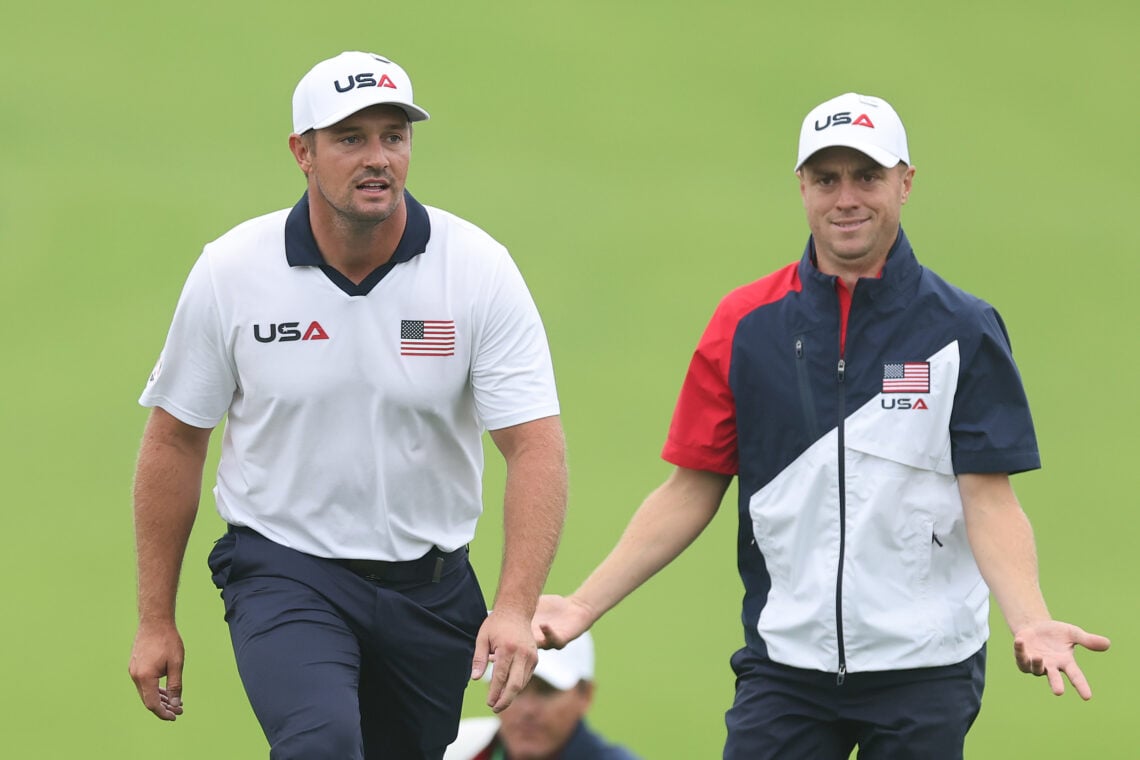

Bryson DeChambeau was a contentious figure at the start of his career.
The outspoken American rubbed golf fans the wrong way with his brash attitude. Calling Augusta National a “Par 67” was one of a long list of reasons why Bryson DeChambeau was an unpopular figure on tour.
He’s since turned that around to become one of the sport’s most beloved players, especially among his online viewership. He has generated a following so significant that Keegan Bradley picked DeChambeau to tee off first and lead the charge for Team USA at the Ryder Cup.
But DeChambeau still divides opinion on and off the course, and what he did in 2019 meant Justin Thomas felt the need to call his fellow American out.
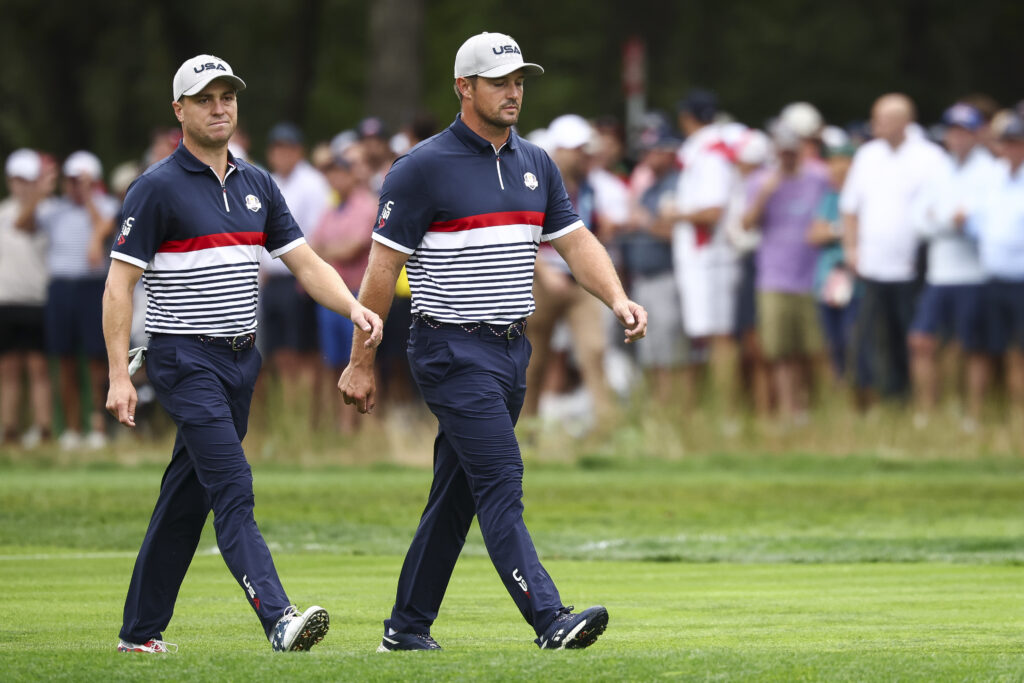
The reason why Justin Thomas called out Bryson DeChambeau
Slow play has been an issue plaguing golf for a number of years. Legends of the game have commented on players’ slow play on tour, and everyone has an opinion on how the PGA Tour should speed things up.
This became such a problem in 2019 that the PGA Tour conducted a review, and DeChambeau was at the center of it after Thomas called him “a slow golfer.”
Speaking after a Northern Trust event, Thomas said, “I hate saying this because I don’t want Bryson to think I’m throwing him under the bus or anything like that, but it’s just unfortunate where the pace of play is in the game at the moment.”
Ironic, because Thomas admitted he’s a slower golfer this year.
DeChambeau was blasted for his slow play when he took more than two minutes to hit a 70-yard chip and a similar time to line up an eight-foot putt.

Two-time European Tour winner Eddie Pepperell posted to Twitter: “Slow players do this to their partners, making the game less enjoyable. Problem is, the unaffected single-minded twit in this instance doesn’t care much for others.”
He then later added, “When it’s as egregious as Bryson was [on Saturday], and if they’re already behind, then shot penalties should be handed out. Fines don’t mean anything to these guys. You’d only need to hand out a few penalties and things would improve quickly!”
Pepperell later apologised to DeChambeau for his comments on Twitter: “That was unnecessary and something I shouldn’t have said.”
Ian Poulter didn’t name DeChambeau, but also weighed in on the debate, saying, “There are a few players that continually disrespect their fellow pros and continue to break the rules without a conscience. It should be self-policed, but clearly this won’t happen… so disappointing it hasn’t been stopped.”
In response, DeChambeau called these comments from his competitors “complete and utter you-know-what,” but the PGA Tour conducted a review and made a series of changes to their rules.
The rule changes the PGA Tour made after Bryson DeChambeau controversy
The PGA Tour made a series of sweeping rule changes to punish slow play after the DeChambeau controversy.
Fines for slow play increased to $50,000, up from $5,000. Using ShotLink data, the tour tracked the speed of play for all players to change their habits.
They created an “Observation List”, putting focus on players whose ShotLink data identified as the slowest players. Those players were given an average of 60 seconds to take shots.
Additionally, the tour said that any player who takes more than 120 seconds to play a single shot without good reason would be issued an Excessive Shot Time penalty. Rules Officials could assess a one-stroke penalty for the second bad time in a tournament, and for every bad time afterwards.
But despite those changes, slow play remains a problem on the PGA Tour. Only three players have been sanctioned for slow play on the PGA Tour since 1995, raising the question of whether the rules are the issue or their enforcement.
Receive exclusive golf news and updates twice a week to your mailbox