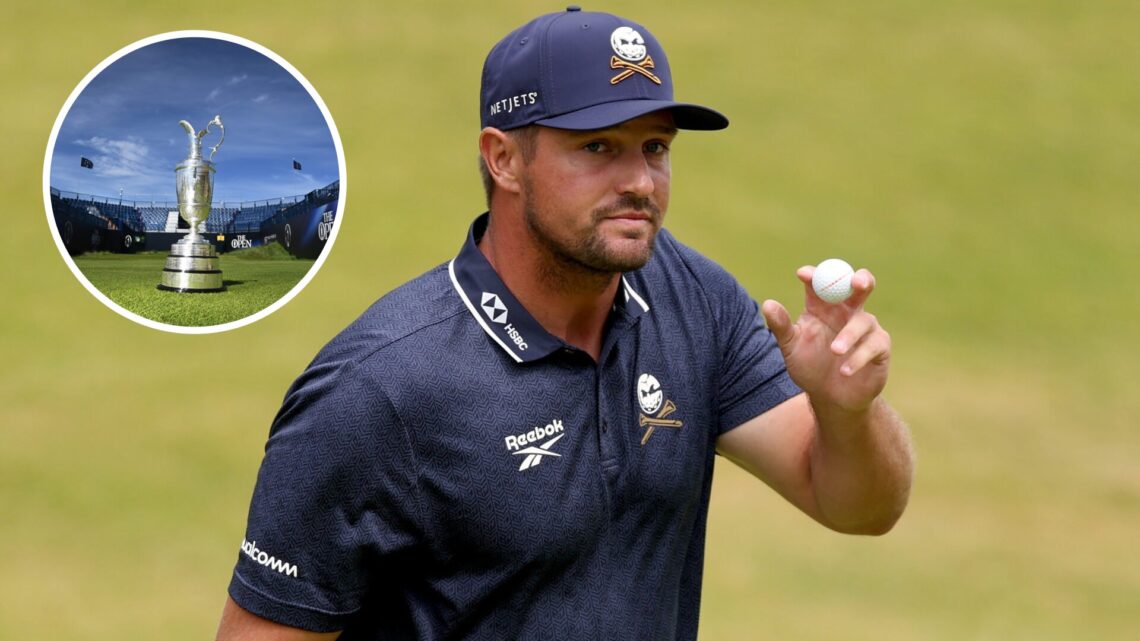

Pace of play has been a huge issue at The Open Championship this week, and Bryson DeChambeau has come up with a novel idea of how to improve things.
DeChambeau has experienced a topsy-turvy Open Championship with rounds of 78, 65 and 68.
Whatever you say about the 31-year-old, he certainly doesn’t lack fight and there is absolutely no quit in him.
DeChambeau said quitting is not in his DNA after his first round at The Open, and he has proven that to be correct on Friday and Saturday.
The two-time major champion would have won over even more fans in Northern Ireland this week, due to his will to fight his way back from well outside the cut-line.
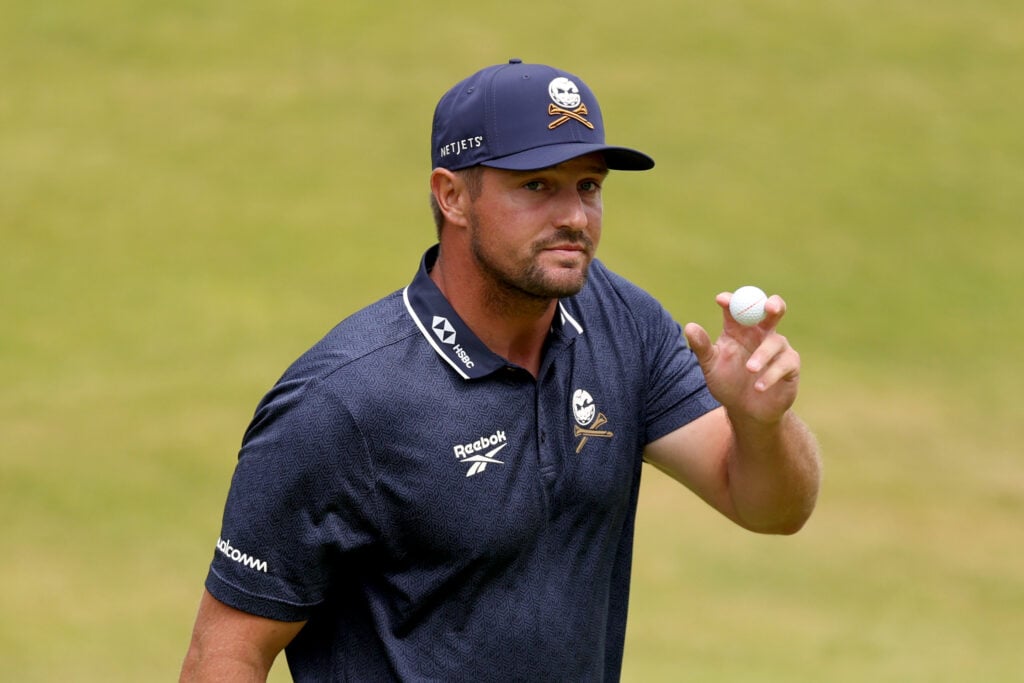
Perhaps the best compliment you could give DeChambeau is the fact that Robert MacIntyre said he was great to play with during the first round, when the American shot a woeful 78.
The sparkling 65 that he fired on Friday was truly exceptional to watch in every way.
However, his round of 68 on Saturday did not pass by without incident.
Bryson DeChambeau reveals why he was put on the clock at The Open
The LIV golfer is extremely methodical when it comes to his game in general.
However, he is certainly not a slow player, so the rounds at Royal Portrush this week must have been extremely hard for him to cope with.
He spoke to reporters after his third round 68 at The Open, and explained how and why he was put on the clock.
DeChambeau was asked if he was put on the clock officially?
He said: “Yeah, I was on 17.“
He was then asked to explain how that went down.
DeChambeau replied: “Yeah, he timed me on 17 after I striped the drive down there. 16, difficult hole, got up-and-down in a difficult spot. Understand we were struggling with pace the whole day. I was moving my butt as fast as I could. Greens were really tricky. I was trying to read them right.
Yeah, we just kept losing time. Unfortunately on the 16-17 exchange, you’ve got a downhill drivable hole you can play pretty quick if you get in the right spot. They did that, and we just lost more time to the group in front of us, and they put us on the clock, which is unfortunate.“
That’s a fair comment from DeChambeau. He wasn’t playing slowly whatsoever. Sometimes it’s just difficult to keep up the pace of play where the golf course is as difficult as Portrush is.
DeChambeau says players are scared of simple solution to slow play
DeChambeau was then asked how to solve the issue of slow play.
The LIV star responded: “It’s very simple. It’s not difficult at all. You eventually time everybody for their whole entire round. Very simple. Nobody wants to do it — because people are too scared to get exposed, which I am an advocate for. I’d love to be timed, and I have no problem with that.
My putting, I’m more deliberate, take more time on that, but when it comes to iron shots, off the tee, I’m pretty fast. It’s like D.J., he’s really slow on the putting greens, and then he’s incredibly fast on his full swing shots, second shots into it.
Everybody plays a different style of game, and that’s just the way it is. I wish it was just a new system.“
So what system would he implement?
He said: “Well, I think it would be more fair towards everybody. If somebody is playing slower, the guy can go up to him and say, hey, man, you’re over par with your time. All you do is you just time them for every single shot. He gets there and puts the bag down, and how long it takes him to hit that shot and how long it takes him to walk to the green. It’s not rocket science.
“You time how long someone takes individually, and then you separate that from the other person playing. You start/stop on him the whole entire thing. It’s one way. I’m not saying it’s the answer. I’m definitely not somebody that has the most experience or knowledge on it. If somebody has a different way of monitoring it, I hope —
“I hope there’s a better system out there at some point in time.
“I truly believe so. Once you start penalising individuals for consecutive over — taking too much time. I can tell you, first two rounds it was out of control what I saw. That’s the way people play.
“Long story short, one day I hope we can have a better system.“
That’s extremely interesting from DeChambeau, and it will be fascinating to see if any of golf’s governing bodies take the American’s advice.
Receive exclusive golf news and updates twice a week to your mailbox