

If you offered amateur golfers an immediate cure to their slice, they’d bite your hand off.
The majority of amateurs suffer from a slice when they’re starting out, and even when you think you’ve eradicated it, the slice has a way of creeping back into your swing.
Who better to offer you a fix to this issue than Tiger Woods’ former coach, Hank Haney, who says he can help 90% of amateurs with this golf tip!
Haney worked with Woods between 2004 and 2010, helping the greatest golfer of all time win six major championships after a difficult 2003 season.
He’s got a unique drill that can help train a new driver swing and prevent the ball from moving left to right.
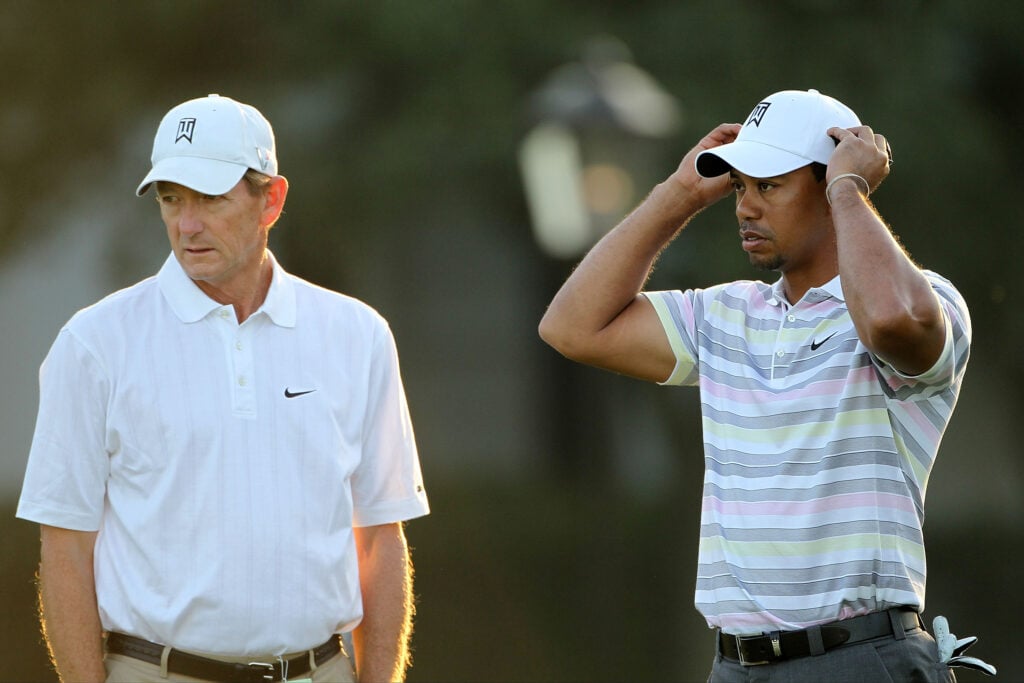
Hank Haney’s golf drill for amateurs to fix their slice
Haney said 90% of amateur golfers suffer with a slice, and he has a drill that can help all of them!
Speaking on Golf Digest’s YouTube, he said, “So, the whole genesis of this article on correcting your slices is that I believe that if there’s a road you take to playing good golf, nowhere on that road is there a slice.
“You can go from slicing to hooking to good golf, or you can go from hooking to good golf. So, when I’m walking down the range, I see all these amateur golfers who fight a slice. Probably 90% of the people that play golf slice, and they all make a loop that kind of goes counterclockwise.
“So, the swing looks like this. They take it inside and then they make this loop that goes counterclockwise over the top. And I thought if there is a way to teach people just a simple system for fixing their slice, I could help 90% of the people that play golf.
“And the concept that I came up with was getting them to swing the club on what is a clockwise motion (starting the swing with the club moving forward, instead of backwards). So I have them take this practice swing. And it starts off just like this.
“Just making a clockwise motion like this. So they learn to get the golf club to come up and then it comes down flatter and more from inside as they come down.
Which would you rather eliminate from your golf game?

“Now this is the beginning part. So you just practice this concept and then as the club gets over the top of your head you turn. So your back is facing to the target. So the first motion up over the top of my head turn my shoulders. Now when my hands get to 3:00 I’m going to turn my hands over as I come through.
“When you set up to the ball, make sure you’ve got a little stronger grip, meaning that your hands are turned to the right. So, you can see at least three knuckles on your left hand and a softer grip pressure, if you will. Hold on as soft as you can. That’ll make it easier for your hands to release.
“So, club up, turn 3:00, turn your hands over. All you got to do, practice this motion first. Then the next step would be to take it to here (the club straight up above your head) and turn.
And then the next step would be to take it up here (90 degrees backwards).
“Now turn. And before you know it, you got a normal you got a normal looking golf swing that’s curving the ball from right to left.”
How changing your grip can stop you from slicing the ball
Haney’s point about how to grip the club is an important one, and could be the key to fixing your slice. Ensuring you’re gripping the club correctly is the key to controlling the clubface.
For the vast majority of amateurs, a slice is caused by an open clubface at impact. While swing-path issues contribute to the curve, the face angle accounts for the ball’s initial direction, and a faulty grip can cause the ball to fly off the club to the right of the target.
Who’s THE MOST overrated golfer in the world?

Most slicers would benefit from moving towards a strong grip. You should see two to three knuckles on your left hand at address, and the V shape formed by your right thumb and index finger should point toward your right shoulder (if you are a right-handed player).
By strengthening a weak grip, you eliminate the open clubface, turning that frustrating slice into a controllable draw and adding distance off the tee.
Receive exclusive golf news and updates twice a week to your mailbox