
Many amateur golfers really struggle during their long and incredibly difficult quest to lower their handicaps.
However, shooting better and more consistent scores is not as hard as some people make out and it certainly isn’t impossible, whatever standard you are.
Golfing Gazette writer Antony Martin spent four years playing on the professional mini-tour circuit in Central Florida, and he has provided a series of golf tips regarding where you might be going wrong on your quest to improve.
How many wins do you think 2000’s Tiger Woods would have if playing in 2025?
And how would it impact Scottie Scheffler's incredible year?

The main problem with most amateur golfers is that they fail to keep the game simple.
In essence, golf is an extremely straightforward game and if you avoid these three key mistakes, you will be well on your way to shooting lower scores.
Three main reasons why many amateurs can’t get their handicaps down no matter how hard they try
Here are the three things which amateur golfers should avoid doing at all costs, if they do indeed want to lower their handicaps.
Trying too hard
This is common for golfers at every single level, even all the way up to the stars on the PGA Tour.
We’ve seen it before with players like Tommy Fleetwood and Colin Montgomerie back in the day when they try to force things to happen rather than let the victories come to them.
The same can be said for mid-range handicap golfers who are trying to get down to single digits or high handicappers who dream of one day playing to an 18 index.
The key is to let better golf come to you.
The worst case of forcing things occurs on the greens.
In order to putt well, you need to be completely relaxed and trying to force your putts into the hole really isn’t conducive to shooting lower scores.
The same can be said for trying to steer your driver down the middle of the fairway. Let me guess, you drive the ball better on the range than you do on the golf course right?
That’s because there is no fear in finding any trouble on the practice ground. Lose your inhibitions and your fear and embrace the game.
Hit your driver and irons with more freedom and do the same with your putter. I guarantee you that playing golf will not only be more enjoyable, but you will shoot better scores for the most part as well.
Practicing without purpose
I see so many amateurs standing on the driving range and beating hundreds of golf balls before leaving and thinking they’ve had a good session.

Then they turn up at their local club to play a round and wonder why they can’t break 90 AGAIN, after all of that ‘work’ they put in on their games.
The key here is to work on one specific drill, or two at the very most.
Have a clear picture of what you’re trying to accomplish when practicing, and split down your time into the 70/30 method.
70% of your time should be spent working on your short game while 30% goes into hitting balls.
Ideally, you will have lessons regularly with your local PGA qualified professional and he will give you the exact drills you need to work on to help improve your weaknesses.
Smashing your driver trying to get your ball speed up as high as you can may be more enjoyable, but in the long run it definitely will not equate to lower scores.
Fail to prepare, prepare to fail
Too much time and effort goes into perfecting the technique with the golf swing these days.
Simply put, not enough amateur golfers make the effort when it comes to the simple things, like improving their course management and strategizing before they play.
Poor on-course decisions equal poor scores
Many amateur golfers play with their hands tied behind their backs at times … not literally, of course.
Poor strategy and course management is where mid-high handicap golfers needlessly throw away most of their shots.
The way to improve your course management can be broken down into two sections.
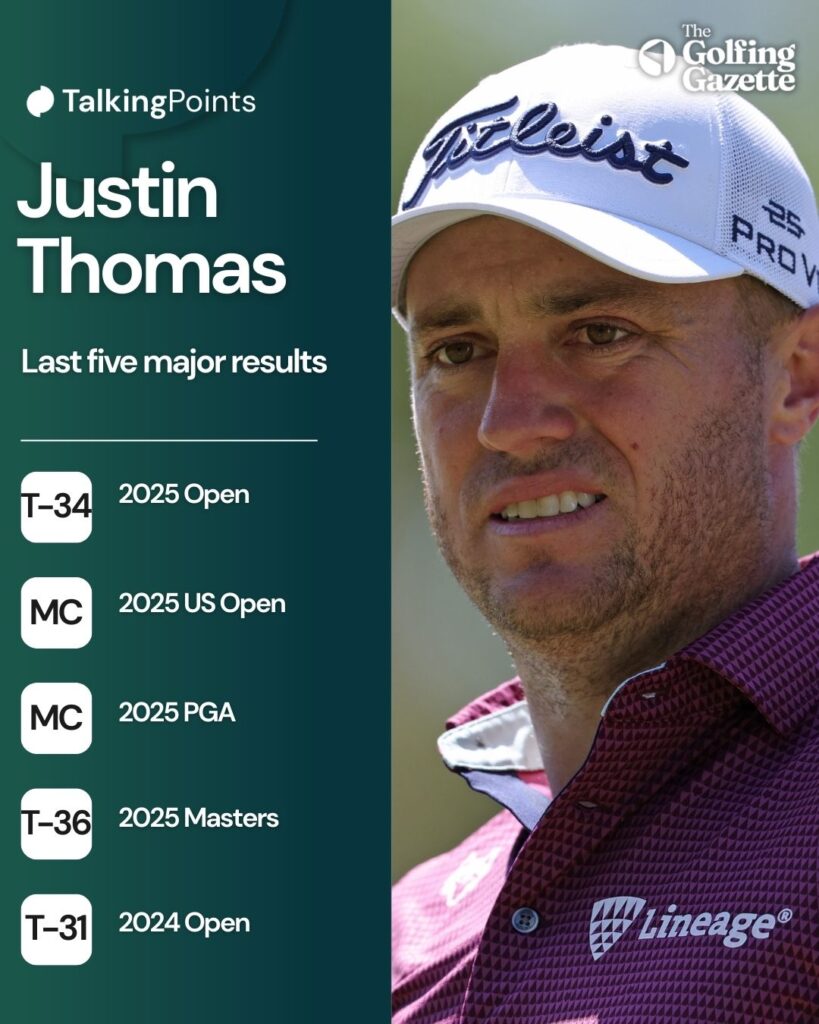
Justin Thomas will never win a major again – change my mind
Firstly, you need to accept that you’re simply not capable of hitting certain shots.
Attempting to take on shots that are out of your league will only exacerbate your problems.
When your ball ends up in the rough, your first job should be to get yourself back in play, it really is as simple as that.
And secondly, devise a strategy whereby you take as much trouble as possible out of play on every single hole.
In order to devise the perfect strategy for yourself, you will need to work on your distances at the driving range and become accustomed to exactly how far you hit each club.
By making small changes and by avoiding the common mistakes listed above, you should be able to get your handicap down in the new year.
Receive exclusive golf news and updates twice a week to your mailbox