
The vast majority of amateur golfers are on a similar never-ending quest to lower their handicaps.
The good news is that there are plenty of golf tips out there to help you all improve your games.
- Read also: Three things amateur golfers can do to improve their handicap this winter without leaving the house
Amateur golfers can lower their handicaps by making some very simple adjustments to their swings and, indeed, their course management.
However, there is an even simpler method to cutting needless strokes off your scores.
What is the one golf rule you would change if you had the opportunity?

And it all revolves around being sensible with the way that you compile your 14-club set.
The five clubs amateur golfers should take out of their bags
If you’re a mid-high handicap golfer, there is simply no need to have certain clubs in your bag.
In fact, anyone who isn’t a single-digit handicapper should consider removing the following clubs from their sets immediately…
Mini Driver
The Mini Driver is all the craze right now in the world of professional golf. Players like Tommy Fleetwood, Rickie Fowler and Adam Scott have made the club popular.
However, mid-high handicap golfers having one in the bag just overcomplicates matters. Practice hard and smart with your driver and learn how to use your natural shot shape consistently. There really is no need for the Mini Driver if you’re trying to break 90.
Long irons (2,3 and 4-iron)
Long irons are incredibly hard to hit. In order to get them airborne, plenty of swing speed and ball speed are required in order to create the spin needed to launch the ball into the air.
2, 3 and 4-irons are also notoriously unforgiving clubs and you will be far better off if you put a hybrid or a 7-wood in your bag. They are far more forgiving and are designed to get the ball in the air as quickly as possible.
All bladed irons
Why make the game harder than it needs to be? Even some of the best players in the world aren’t using bladed irons anymore!
Rory McIlroy has just switched out his bladed 4 and 5-irons for cavity back clubs. Cavity back or muscle back irons are far more forgiving and they get the ball airborne much quicker and easier than blades do.
Wedge choice and putter model crucial to making the game easier
Remember, this is all about making the game easier for the average golfer, rather than unnecessarily more difficult!
60 degree wedge
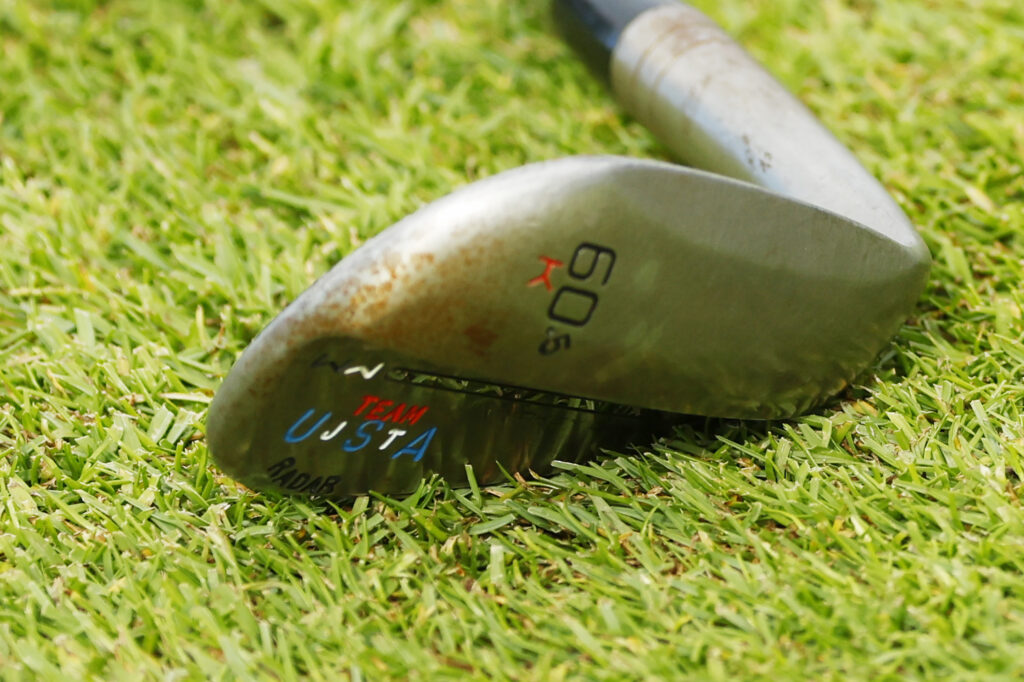
We’ve all marveled at Phil Mickelson’s uncanny ability to pull off the flop shot when he has a hazard between his ball and the hole, and has minimal green to work with.
However, you have to possess some serious skill to pull that shot off consistently with a 60 degree wedge. There really is no need to take the risk and there is absolutely no reason why a mid-high handicap golfer should have anything more than a 56 degree wedge in their bag.
Bladed putter
Just like bladed irons, bladed putter models are simply more difficult to hit out of the sweet spot consistently.
The best bet for amateur golfers is to use a mallet-headed putter.
More and more golfers have switched to the mallet model over the past few years including the likes of Rory McIlroy, Tommy Fleetwood and Scottie Scheffler.
A blade putter needs to be used with more face rotation throughout the stroke while mallet models can be swung straight back and straight through.
Golf is all about enjoyment, and by getting rid of your Mini Driver, long irons, bladed irons of any kind, 60 degree wedge and bladed putter and replacing them with clubs which are simply easier to hit, you will most likely shoot better scores on a more consistent basis.
Receive exclusive golf news and updates twice a week to your mailbox