
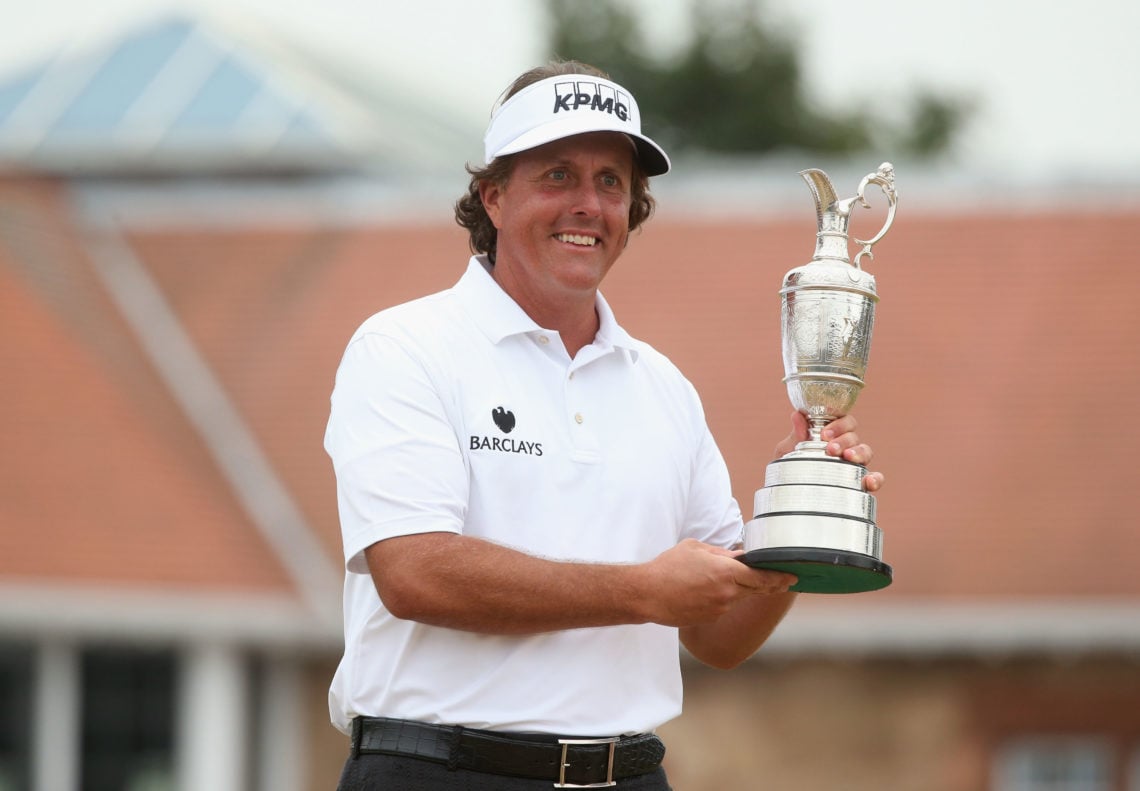

Phil Mickelson believes amateur golfers could be making a big error when playing short chips around the green.
The lefty, as most of the golfing world knows, is one of the game’s best short-game players. Mickelson’s touch around the greens played a significant role in his six major championship victories.
Mickelson places plenty of weight on the fundamentals and also believes many amateur players fail to set up correctly.
The lefty also says that hinging the wrists in the backswing is something which perhaps gets overlooked.
Phil Mickelson’s ‘correct’ chipping method

Speaking in a social media clip, Mickelson explained how hinging the wrists can help improve contact with the ball.
“The one correct way of doing it is a method I call hinge and hold. Every great chipper does it and refers to it in their own way. They break their wrist immediately, causing a much steeper angle of attack when they go through the ball,” Mickelson said.
“Now the club is way up here, and my arm has barely moved. From there, I hold it or accelerate it going through. I break going back, and I hold it going through. If I take the club back here and accelerate through the finish, the ball is going to go flying past the pin. We have got to be able to hit chip shots aggressively and not have the ball take off on us.”
Mickelson stressed the importance of keeping hands moving toward the hole. Failure to do so may result in fat or thin shots.
“We also have to continue our hands to the hole. If the hands stop at the club and keep going, that is the kiss of death. You have no chance if your hands stop at impact. A couple of things happen. The leading edge starts coming up off the ground and increases bounce, raising the leading edge even more. Or you’re going to hit fat. We have to hit the leading edge and bounce the same as long as we can.”
Why amateur golfers must improve chipping
High-handicap golfers miss a significant portion of their greens in regulation, so having a decent short game is essential. If a 15-handicap golfer can get up and down 40% of the time after missing a green in regulation, shots will be saved.
Shots inside 100 yards typically make up around 60% of a round. So it’s clear where 60% of a golfer’s focus should lie. The PGA Tour average scramble rate is around 60%, and this number increases significantly as we head up the handicap brackets.
A scratch golfer will get up and down 55% of the time, a five handicapper 40%, a ten handicapper 32% and a 20 handicap player 19%.
On average, a scratch player gets up and down nearly three times more often than a 20-handicap golfer. By following Mickelson’s advice and improving up-and-down success rate, amateurs could see their handicaps decrease significantly.
Receive exclusive golf news and updates twice a week to your mailbox