

Getting down to a single-digit handicap is something that many amateur golfers dream of doing.
However, breaking the 10-handicap barrier is not as difficult as it seems, if you have time to practice, of course.
- Read also: How to get your handicap down quickly when you only have one hour to spend on the driving range
The key message to every golfer looking to improve is that you don’t have to be perfect to play to a single-digit handicap.
In order to play off nine, for example, you just need to shoot nine strokes over the course rating on average in eight of your last 20 rounds.
There are small changes every single person can make to their golf game which can help them shoot lower scores.
Here are three of the best golf tips for those of you who are looking to get to a nine-handicap or below
*Antony Martin is a former professional golfer, who played professionally on the Moonlight Golf Tour and the Grey Goose Gateway Tour in the United States in the early 2000s, winning three times. He competed against numerous big name players including Graeme McDowell in US Open qualifying and 2018 Pebble Beach Pro-Am winner Ted Potter Junior. Before turning pro, he held a career-low handicap of +4 and represented the county of Essex and England schoolboys. He now writes about the sport for a living.
How mid-handicap golfers can get down to single digits
‘Drive for show and putt for dough’ may well not be necessarily true but one thing cannot be debated. You can still score well if you drive the ball poorly whilst putting well but it’s impossible to do the other way around.
The secret lies in improving your putting
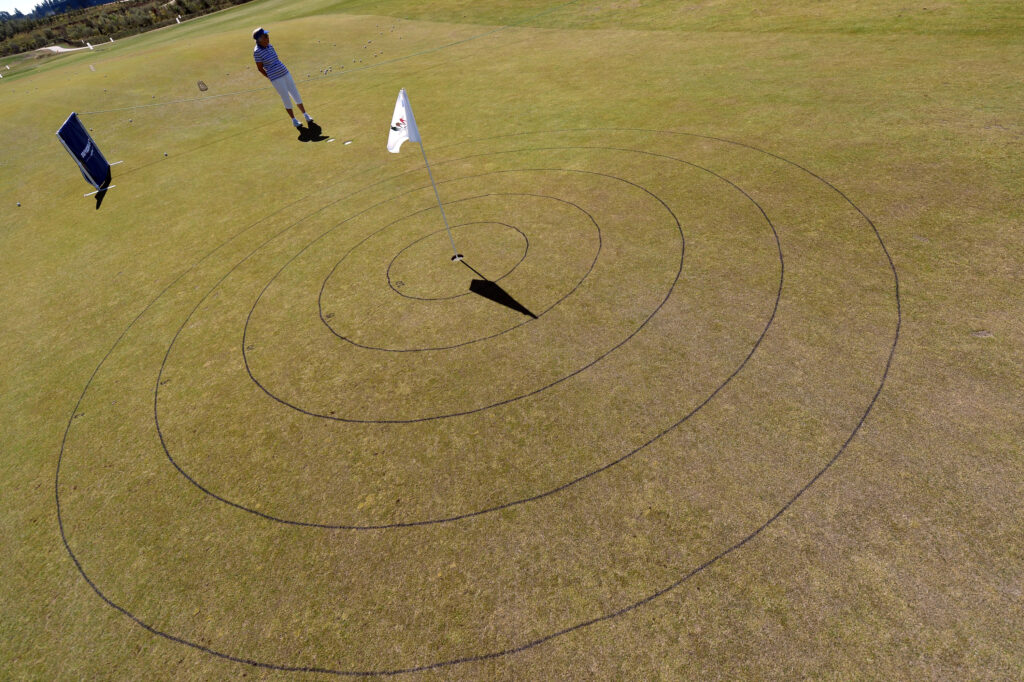
So let’s say you’re a 15-handicap golfer looking to get down to nine or below, the first place you should start on your quest is on the putting green.
From stats and data obtained via Shot Scope, putting is a crucial area to improve on, if you want to lower your handicap.
For instance, five-handicap golfers average around 30 putts per round, while 15-handicappers average 32 putts per round.
Meanwhile, a five-handicapper will average two three-putts fewer per round than someone who plays off 15.
Practice your distance control from long putts by putting a tee two feet behind the hole and two feet in front of the hole.
The aim of this is to lag your putts up inside that four-foot area. If you improve your pace control on long putts, you will be able to limit the amount of time you three-putt, therefore reducing your scores.
Then, on short putts, the key is to keep your head and your body still with your eyes fixed on the ball.
Putting guru Phil Kenyon once said: “A common mistake I always see, I think stems from anxiety on short putts. We know we’ve got to make these putts, it puts a lot of pressure on us and as a consequence, I will typically see a lot of movement, I’ll see a lot of eye movement and head movement before impact.
“That’s going to make it difficult to strike the ball in the center, control your face angle and start your ball on line.
“Once you’ve got your ball lined up at your read, step in, line up your putter, look down at the hole and as you come back, I want you to have left a very small gap between the club and the ball. As your eyes come back from the hole to the ball, I want you to pick a blade of grass directly behind the ball and I want you to focus on that blade of grass.
“But whilst you look at that blade of grass, I want you to be aware of where your target is in the distance. So we’re looking at the blade of grass but we have an awareness of where our target is in our mind’s eye.
“I step in, I’ve got my line, I leave a little gap, I can see that blade of grass, look down at my target, come back, look back at the blade of grass, I can sense the target and when I stroke the ball, my eyes will be looking at that blade of grass.
“Now, if you do that successfully, you will almost see an after-image, after you strike the ball. Whether you see the after image or not, the fact that the ball is on its way that means you have stopped peeping for the ball. That’s going to keep your body quieter, more importantly your eyes quieter and that’s going to enable you to put a good stroke on it.“
Sound advice indeed from one of the best putting coaches on the planet.
Chipping and bunker play have to become more consistent
A common misconception is that single digit handicappers are good chippers and proficient with their bunker play.
However, the truth of the matter is that they aren’t, but they don’t waste needless shots by thinning, chunking or shanking their chips/bunker shots.
If you chip onto the green and two-putt, it really isn’t the end of the world. It’s those occasions when you take four or five shots from the edge of the green that really wreck your scorecard.
Shot selection is key. If the pin is located towards the back of the surface and you have plenty of green to work with, a club with less loft will do the job, something like an eight-iron, a nine-iron or a pitching wedge.
This is a fairly straightforward shot to pull off. Just put the ball in the back of your stance and hit down on it. Practice will be required to help you improve your distance control.
However, if you have an obstacle like a bunker between your ball and the hole, more loft is obviously required and for this shot, the trick is to hit down on the golf ball and let the loft do the work for you.

Far too many mid-high handicap golfers try to help the ball in the air by leaning back and flipping their wrists, when you should be doing the exact opposite.
The more you practice, the more your confidence will increase regarding the feeling of what you need to do.
However, the crucial thing to note is always play percentages. You don’t need to hit your shots to tap-in range. Remember, getting down in three shots from off the green is not something that will ruin your scorecard!
Sensible golf equals lower scores for mid-high handicap golfers
Learning how to miss on the right side of the golf course is crucial for those who want to improve their scores.
Course management is crucial to lowering scores
So many amateur golfers throw silly shots away by pulling out their driver on every single par-four and par-five or by not playing sensibly with their approach shots to the greens.
Firstly, you need to know exactly how far you carry your driver through the air and then how far you hit it in total.
This way, you can learn to avoid as much trouble as possible. If there is a bunker 230 yards from the tee and you hit your driver 240 yards, pull out your three or five-wood.
If there is a lake that requires a 230-yard carry and you can only carry your driver 220 yards through the air, find out how far it is to reach the water and take a club that you know won’t reach the hazard.
Similarly, when you’re hitting into greens, always err on the side of caution.
If there is a pin tucked tight to the left, ensure that you give yourself some leeway by aiming at least 10 yards right of the pin.
Some of the best golfers of all-time have done this throughout their career, Jack Nicklaus and Tiger Woods included.
Short-siding yourself is the quickest way to run up big numbers around the greens. If you play percentage golf both off the tee and with your approach shots, there is a good chance that you’ll start lowering your scores.
Putting in the hard work and practice on and around the greens will help get down to a single-digit handicap.
However, changing your mindset on the golf course will be just as key to your hopes of lowering your handicap.
Receive exclusive golf news and updates twice a week to your mailbox