


While Tiger Woods probably had more golden periods in his career than anyone to have ever played the game of golf, it was his 2000 season which perhaps saw the 15-time major champion at the very peak of his powers as he won nine times.
It was during the 2000 season where Tiger Woods won three majors – before going on to complete the Tiger Slam at the 2001 Masters – while he also triumphed at Pebble Beach, Bay Hill and The Memorial.
During the early stages of his career, Woods was working with Butch Harmon. The pair would enjoy all kinds of success together before going their separate ways in 2002. Woods has subsequently worked with the likes of Hank Haney, Sean Foley and Chris Como.
The swing fault Butch Harmon had Tiger Woods correct early in his career
Obviously, Woods’ unbelievable talent played a key role in the success he had. But it appears when he and Harmon started working together, he was making a common mistake which is also seen in a lot of amateurs.
And in 2000, Harmon outlined what he had Woods do in his swing to correct a fault which he actually saw much more frequently than many would perhaps realise.
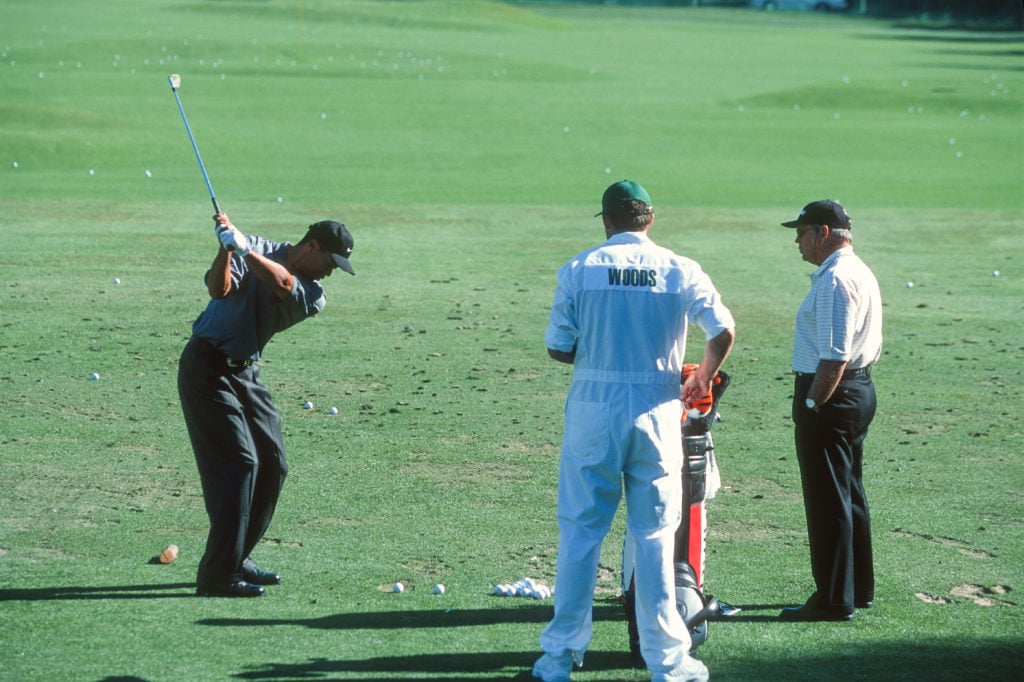
“Let’s take a setup here and we’ll talk a little bit about your takeaway where we’re trying to get the club which you feel is a little earlier wrist set, and the key here is just to keep the right arm higher than the left,” he said.
“So many people get this club, as you did when you were younger, tucked in on the inside, and then when you go to the top of your swing, probably the biggest change that Tiger’s made is that he’s really tried to get his hands in front of himself coming down, in other words, arms in front of the body.”
One of the most baffling decisions of Woods’ career
Woods would enjoy a lot of success once his partnership with Harmon came to an end. Seven of his 15 major championships have come since the two parted ways. However, when you compare his record while and after working with Harmon, it does appear that he made an error moving on.
Woods won eight majors in six seasons between 1997 and 2002, while six more came in the same amount of time up until the end of 2008.
However, the numbers become even more striking if you put his 1997 Masters win to one side for a moment. Suddenly, Woods has seven majors between 1999 and 2002.
It is almost pointless to suggest it, but had Woods continued with the success rate he had between 1997 and 2002, he would have potentially won 16 majors by the end of 2008.
So while Woods would have still had one of the all-time great careers had it started in 2003, it does appear, from the outside, that splitting with Harmon was one of the more baffling decisions he made when it came to his game.
Receive exclusive golf news and updates twice a week to your mailbox