

There is perhaps no stretch of holes anywhere in the world that is as iconic as the 11th, 12th and 13th at Augusta National – the section of the course most fans know as Amen Corner.
The Masters has provided so many historic moments since the event began in 1934. Every single part of the immaculate golf course, hidden away amongst the Georgia pines, has seemingly been the site of a tournament-defining shot.
But it is the three holes immediately after the tricky 10th which often seem to have such a large say in which player will be wearing the Green Jacket in Sunday’s fading light every April.
It is hard to imagine now that there was a time before the three holes – officially called White Dogwood, Golden Bell and Azalea – were collectively known as Amen Corner.
To be exact, the ‘Corner’ is thought to start from the second shot on 11 and continue halfway up the 13th.
But before The Masters in 1958, the term may have been unheard of to anyone who was not a fan of jazz music.
How Arnold Palmer overcame controversy to win his first major title at The Masters in 1958
The first major of 1958 was certainly significant.
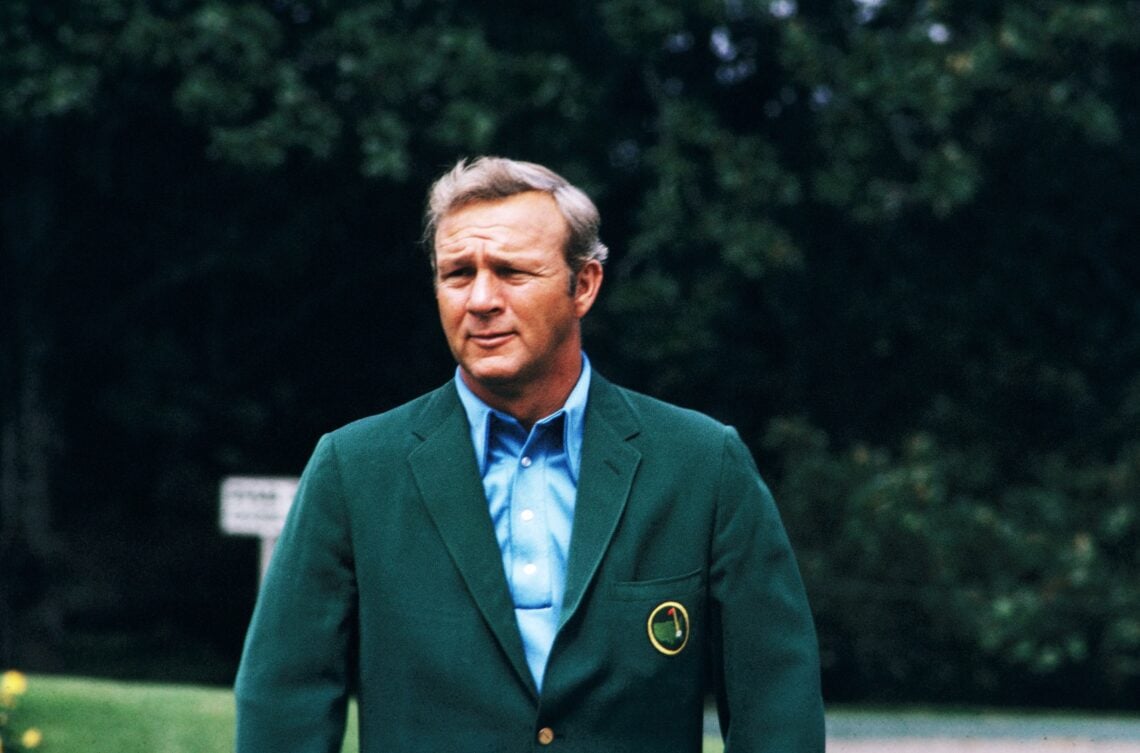
Arnold Palmer went on to win the first of his seven major championships at Augusta National. The King moved into a tie for the lead after the third round before securing victory by one shot.
However, his win was not without controversy.
Palmer had initially made a double bogey on the par three 12th in the final round. It came after he had requested a ruling after feeling that his ball was embedded behind the green.
Heavy rain had meant that a lift, clean and drop rule was in place. However, the official had decided that Palmer was not entitled to a free drop.

As Herbert Warren Wind noted for Sports Illustrated at the time, the American was not done with the 12th hole once he had made his five.
He wrote: “Then the situation became really confusing. Palmer did not walk off the green and head for the 13th tee. He returned to the spot in the rough just behind the apron where his ball had been embedded and, with the member of the rules committee standing by, dropped the ball over his shoulder. It rolled down the slope a little, so he placed the ball near the pit-mark. Apparently, now, the official had not been sure of what ruling to make and Palmer was playing a provisional or alternate ball in the event it might later be decided he had a right to lift and drop without penalty. He chipped stone-dead again and this time holed the putt for a 3. Now the question was: Was Palmer’s score a 3 or a 5?“
Palmer did not let the uncertainty knock him off his stride. He made an eagle on the 13th.
He would be informed on the 15th hole that his par on 12 would indeed count. With that, Palmer was able to make bogeys on the 16th and 18th and still get across the line.
The drama surrounding Palmer prompted Wind to use the term, ‘Amen Corner’ in his piece recapping the tournament for Sports Illustrated.
The origins of Amen Corner, with Jack Nicklaus previously unaware of where the term came from
Interestingly, the writer seemed reluctant to take credit for the name. As noted by Golf Digest in 2008, Jack Nicklaus had no idea Wind had literally written Amen Corner into Masters lore.
“I never knew Herb named Amen Corner,” he said. “He never told me that. I wouldn’t have heard it in 100 years from him.”
It turns out that the term had come from a song he had heard in the 1930s called ‘Shoutin’ In That Amen Corner’.
Wind explained in 1993 how it crept into his writing more than two decades later as he attempted to sum up what he had seen at Augusta National.
“Everyone called it ‘the Corner,’ like I’ll see you at ‘the corner’,” he said. “So I was trying to think of something like the hot corner in baseball or the coffin corner in football. Then somehow my mind did land on a jazz record I had bought in college by a Chicago bandleader named Mezz Mezzrow. One side was ‘Shoutin’ in Amen Corner,’ a jazz version of a spiritual. And I thought, Gee, that is as good as you can get.”
Strangely, Golf Digest noted that Mezzrow is believed to have never actually recorded the song.
Instead, the most famous version features vocals from Mildred Bailey and was recorded with the Dorsey Brothers’ Orchestra.
It was only in 2007, nearly two years after Wind’s death, that it came to light that the legendary sportswriter must have misremembered where the song had come from.
While there may be some doubt over where Wind would have heard the song, what cannot be disputed is that one of golf’s most famous nicknames came from his decision to include the words ‘Amen Corner’ in his copy two decades later.
Receive exclusive golf news and updates twice a week to your mailbox