
The US Open is golf’s toughest test.
The USGA has forged the US Open’s reputation as the most difficult challenge professional golf can muster. Their aim is for every single one of the best golfers on the planet to be brought to their knees, made to look like weekend hackers every single year.
At last year’s US Open at Oakmont, JJ Spaun was the only under-par finisher, and it took a bomb putt on the 72nd hole for him to get to one under par.
And this week at Shinnecock Hills, one of the most challenging golf courses on the planet, where only three players have finished under par at a US Open in 100 years, we’re expecting something similar.
But on a number of occasions, the USGA has tried to walk the tightrope of making the golf course ridiculously hard yet not physically impossible, and has slipped and fallen. They have turned this event into an outright farce multiple times, and have even been forced to issue apologies to the players and fans.
So here, we’re taking a look at the five toughest US Opens of all time.
5. 2006 Winged Foot
Winner: Geoff Ogivly (+5)
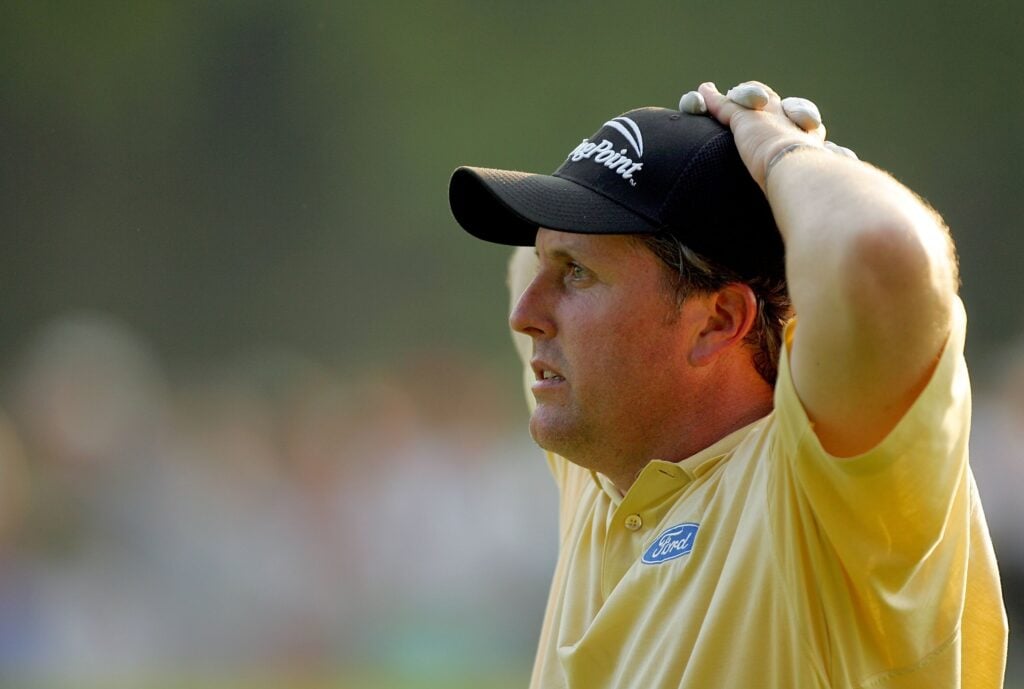
We’re kicking off this list with a classic, the 2006 US Open at Winged Foot. This event has stood the test of time, remembered as the graveyard for Phil Mickelson’s dreams of a career grand slam. But this was also one of the most difficult tests of golf ever produced.
Mickelson stood on the 18th hole of Winged Foot needing just a par to win his first US Open. On most other days, that’s a simple task. On this day at Winged Foot, there’s a reason he melted down.
The USGA designed a layout with extraordinarily narrow fairways bordered by ensnaring rough. It was described by defending champion Michael Campbell as a golfer’s nightmare, and Mickelson said the golf course was on steroids.
That makes for a tough test on any golf course, but with Winged Foot’s greens being lightning fast, if you got out of position on Winged Foot that year, kiss goodbye to a par. You’d snap someone’s hand off for a bogey after a missed fairway.
This caused carnage on the leaderboard. Tiger Woods missed the cut at a major for the first time in his professional career, although this was his return to pro golf after the passing of his father.
The course completely broke the field on the final day. Champion Geoff Ogilvy secured his victory with a score of 5-over par, the highest winning score at the U.S. Open in over three decades.
He survived the course, and Mickelson’s collapse on the final hole, to win one of the most brutal majors of all time.
4. 1955 The Olympic Club
Winner: Jack Fleck (+7)
The 1955 US Open at The Olympic Club is remembered as the time Ben Hogan was coronated early, but it also makes this list as one of the five most difficult US Opens ever.
The defence of the course, as it has been for many US Opens, was its brutal rough. The USGA allowed the grass next to the extraordinarily narrow fairways to grow thick and heavy, which was made even more difficult by the damp air from the Pacific Ocean.
Fog swept the grounds of Olympic Club, which meant the rough wrapped around the hosel of the club, twisting the face and making distance control impossible
This relentless test was made even tougher by the small, domed greens, which repelled golf balls. Plus, the uneven lies from the undulating fairways meant it was so difficult to get the accuracy needed to find these tiny greens.
Who do you fancy to be the next first-time major champion?
So many elite players are still searching for their first major title…

The difficulty of the setup completely broke the field. The tournament’s cut line fell to 15-over par, and over the course of the entire week, only seven individual rounds were recorded under par.
Even the legendary Ben Hogan succumbed to the physical toll of the course. In the 18-hole Sunday playoff, Hogan famously hooked his tee shot on the 18th hole into the dense rough. The grass was so thick that it took him three desperate hacks just to advance the ball back to the fairway, resulting in a double-bogey.
Now Hogan, entering the clubhouse at seven over par, was congratulated in the clubhouse and crowned champion. Gene Sarazen, providing television commentary, congratulated him on the win and the NBC broadcast went off the air after proclaiming Hogan the champion.
No one could imagine that what was about to happen was in the realm of possibility. Jack Fleck was two strokes behind playing the 15th. But Fleck then made birdie on 15 and pars at 16 and 17. Needing a birdie on 18 to tie Hogan, Fleck played his approach from the edge of the rough to 8 feet then knocked in the putt for to force an 18-hole playoff on Sunday. In these conditions with this setup, it was superhuman.
Fleck won the playoff the next day in one of the most stunning upsets in golf’s history.
3. 2004 Shinnecock Hills
Winner: Retief Goosen (-4)
Now the winning score of this US Open might be significantly lower than the others on this list, but don’t let it fool you, this was as much of a massacre as the rest of them. It was so bad, that the USGA were forced to threaten the integrity of the entire tournament just to keep the event alive.
In order to make the golf course as fast and firm as humanly possible, the USGA ordered Shinnecock grounds staff to stop watering in the entire week’s build-up to the event. That was a huge error.
By Sunday, the greens had died, baking into hard, brown surfaces completely devoid of moisture. Golf balls could not hold on the putting surfaces, even after perfect shots. Even routine chips, and putts, were rolling off the greens.
This reached its peak on the par 3 seventh hole. Players could not keep their ball on the putting surface in a situation that escalated so much that the USGA was forced to take the unprecedented step of having the grounds crew manually water the green with hoses between groups during the actual final round just to make it playable.
If a group had a particularly bad hole, the staff would come out and water the green, making it easier for the next group. This threatened the integrity of the whole event, and players like Mickelson were not happy about it.
The scoring average for the field on Sunday skyrocketed to a shocking 78.7. Out of the remaining players who made the cut, not a single golfer managed to shoot under par in the final round.
Retief Goosen ultimately won the tournament at 4-under par, surviving the weekend with Mickelson two shots behind him.
2. 1974 Winged Foot
Winner: Hale Irwin (+7)
Back to Winged Foot for number two on this list, as we take a look at how the Massacre of Winged Foot earned its name.
The USGA entered the 1974 US Open with revenge on their mind, which is always dangerous coming into this event.
The previous year, Johnny Miller had scorched Oakmont with a record-shattering final-round 63. The USGA was deeply embarrassed by the low score and designed the 1974 layout to guarantee it would never happen again.
Championship Committee chairman Sandy Tatum famously defended the setup, saying, “We’re not trying to embarrass the best players in the game. We’re trying to identify them.”
To identify them, the USGA turned Winged Foot into a fortress. The primary weapon, again, was the rough, which was allowed to grow to a staggering six to ten inches deep. It was so thick and matted that champion Hale Irwin said that simply “advancing the ball 100 yards from the rough was an achievement.”
If players did manage to gouge their balls out of the jungle, they faced greens running at an estimated 13 to 14 on the Stimpmeter, speeds virtually unheard of in 1974. The putting surfaces were rock-firm and heavily contoured.
Who will win the US Open this week? 🏆
Scottie Scheffler is going for the career Grand Slam! 🏌️
In the opening round, Jack Nicklaus famously hit a putt from 20 feet on the first green that gained speed, missed the cup, and rolled entirely off the putting surface. That was a red flag.
Not a single player broke par in the first round, and 44 players shot an 80 or worse. The 36-hole cut fell at a historic 13-over par. Across all four days of competition, only seven sub-par rounds were recorded out of the entire field.
Tom Watson held the 54-hole lead but collapsed on Sunday with a 79. Ultimately, Hale Irwin survived the slaughter to win his first major title with a total score of 7-over par.
1. 1963 Brookline
Winner: Julius Boros (+9)
Julius Boros’ nine-over-par victory remains the highest winning score in relation to par in the post-WWII era.
Like all of the US Opens on this list, Brookline was set up with narrow fairways bordered by thick rough. Combine that with the tree lines and blind shots, and this was designed to be a super difficult test of golf.
But what really transformed the 1963 U.S. Open into an absolute war of attrition was the weather. During the final rounds, ferocious winds whipped across the exposed golf course, reaching sustained speeds of 30 to 40 miles per hour.
The gales dried out the already firm greens, turning them into slick, unpredictable surfaces where putts would easily catch the wind and roll offline. The wind made club selection a complete guessing game, sending well hit iron shots everywhere but the greens.
The resulting scores reflected the conditions. Jack Nicklaus missed the cut entirely, and severe collapses occurred all the way down the leaderboard on Sunday. Arnold Palmer, Boros, and Cupit struggled just to stay upright.
Ultimately, those three players finished 72 holes tied at a staggering 9-over par—the highest score relative to par to make a U.S. Open playoff in the modern era.
Boros eventually won the 18-hole Monday playoff, but the enduring legacy of 1963 was a week where survival required absolute psychological fortitude against a course and climate that showed no mercy.
In a tournament that tries to offer the most difficult test in golf, 1963 at Brookline stands well above the rest in US Open history.
Receive exclusive golf news and updates twice a week to your mailbox